Last updated: May 2, 2026
The most effective non-surgical anti-aging treatments available in 2026 include RF microneedling, CO2 laser resurfacing, Ultherapy, regenerative therapies like PDRN salmon DNA facials, biostimulatory injectables, and advanced chemical peels. For those seeking anti-aging treatments in Toronto, these options are widely available at accredited med spas and deliver measurable results with minimal downtime, no general anesthesia, and no surgical recovery.
Key Takeaways
- RF microneedling combines radiofrequency energy with controlled micro-injuries to stimulate collagen, typically requiring 3 to 4 sessions with only 1 to 3 days of redness.
- CO2 laser resurfacing remains the most impactful single-treatment option for wrinkles, sun damage, and uneven texture, with skin refinement continuing for several months post-treatment.
- Ultherapy uses focused ultrasound to lift and tighten skin without needles or downtime, with visible results appearing gradually over 2 to 3 months.
- Regenerative treatments (PDRN, exosomes, PRP/PRF) are the dominant trend in 2026, with search interest in salmon DNA therapies rising by over 120% year-over-year.
- Biostimulators like Sculptra work by triggering the body’s own collagen production rather than simply adding volume, making results more natural and longer-lasting.
- Chemical peels remain one of the most customizable and accessible options for pigmentation, fine lines, and dull texture.
- Treatment selection should be based on specific concerns: laser for sun damage and lines, RF microneedling for laxity and scarring, peels for pigmentation and tone.
- Most treatments can be combined for enhanced results, and a qualified provider will often recommend a layered protocol.
- Toronto has a well-developed medical aesthetics market with multiple clinic locations across the GTA offering these services.
- A professional skin consultation is the most reliable starting point before committing to any treatment plan.
What Are the Best Non-Surgical Anti-Aging Treatments in 2026?
The best non-surgical anti-aging treatments in 2026 are those that stimulate the skin’s own repair and regeneration mechanisms rather than masking signs of aging temporarily. Treatments like RF microneedling, CO2 laser resurfacing, Ultherapy, and regenerative injectables consistently deliver the strongest outcomes across a broad range of skin concerns.
The landscape has shifted noticeably over the past few years. Patients are less interested in purely cosmetic fixes and more drawn to treatments that genuinely improve skin biology. Perhaps that’s why regenerative therapies have taken such a prominent position this year. There’s something reassuring about the idea that your skin is doing the work, not just being filled or frozen.
That said, the “best” treatment is always relative to the individual. Someone dealing with deep sun damage and coarse texture will need a different approach than someone focused on early jowling or under-eye hollows. The table below offers a useful starting framework.
Treatment Comparison Table: 2026’s Top Non-Surgical Options
| Treatment | Primary Concern | Sessions Needed | Downtime | Longevity |
|---|---|---|---|---|
| CO2 Laser Resurfacing | Wrinkles, sun damage, texture | 1, sometimes 2 | 5–10 days | 1–3 years |
| RF Microneedling, Morpheus8 | Laxity, acne scars, texture | 3–4 | 1–3 days | 12–18 months |
| Ultherapy | Skin laxity, lifting | 1–2 | None | 12–18 months |
| PDRN / Salmon DNA Facial | Overall quality, healing, glow | 3–6 | Minimal | 6–12 months |
| Exosome Therapy | Cellular regeneration, radiance | 1–3 | Minimal | Varies |
| Sculptra, Biostimulator | Volume loss, collagen depletion | 2–3 | 1–2 days | 2+ years |
| Chemical Peel | Pigmentation, tone, fine lines | 1–6, series | 2–7 days | 3–6 months |
| PRP / PRF Microneedling | Texture, tone, hair and skin | 3–4 | 1–2 days | 6–12 months |

What Makes RF Microneedling and Laser Resurfacing So Effective?
RF microneedling and laser resurfacing are effective because they create controlled injury to the skin, triggering a wound-healing response that produces new collagen and elastin. The difference lies in depth, mechanism, and recovery.
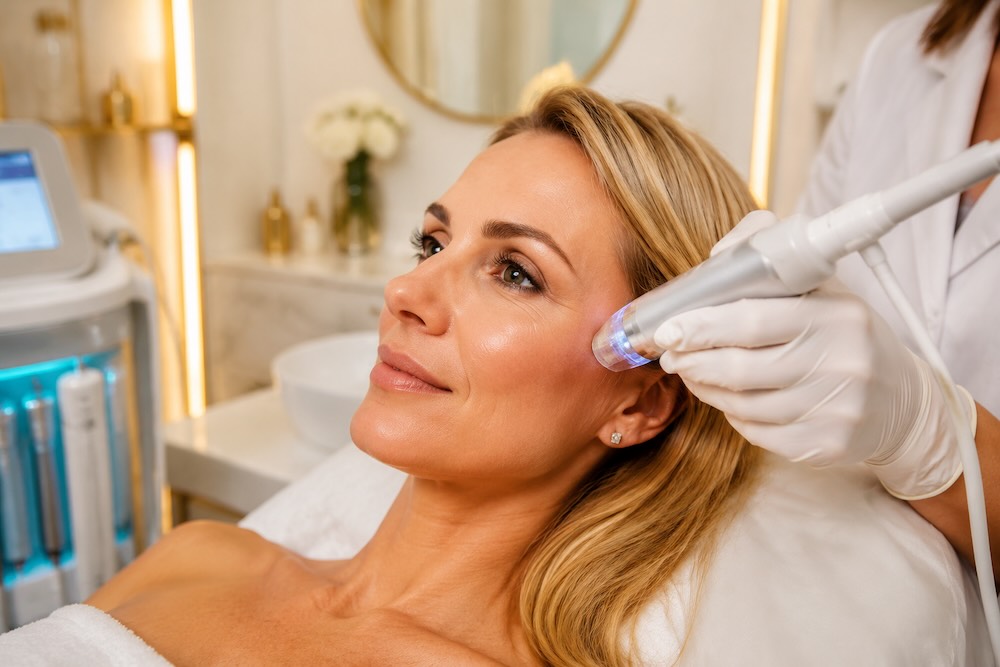
RF Microneedling (such as Morpheus8) delivers radiofrequency energy through fine needles that penetrate the dermis at precise depths. This dual-action approach remodels both the surface and the deeper structural layers of the skin. It’s particularly well-suited for mild to moderate skin laxity, acne scarring, enlarged pores, and uneven texture. Most patients need 3 to 4 sessions, spaced about four weeks apart, and experience only 1 to 3 days of redness or mild swelling. That’s a fairly manageable recovery for the level of improvement it delivers.
CO2 Laser Resurfacing, on the other hand, is a heavier-hitting treatment. It remains the gold standard for significant skin renewal, addressing wrinkles, sun damage, scars, and rough texture in a way that few other non-surgical options can match. One session can produce dramatic results, though the skin continues to refine itself over several months as collagen remodels. The trade-off is a more involved recovery, typically 5 to 10 days of downtime.
For those who want something between those two in terms of intensity, fractional laser skin resurfacing offers a customizable middle ground. Newer platforms like UltraClear® allow providers to dial in the treatment intensity, which shortens recovery while still addressing fine lines, pigmentation, and pore size meaningfully.
Choose RF microneedling if: you want to address laxity and acne scarring with minimal downtime and a gradual series of treatments.
Choose CO2 laser if: you’re ready for more significant results and can accommodate a longer recovery period.
How Do Regenerative Treatments Like PDRN and Exosomes Work?
Regenerative anti-aging treatments work by introducing bioactive molecules into the skin that signal cells to repair, regenerate, and produce structural proteins like collagen and elastin. Rather than adding a filler or relaxing a muscle, these treatments essentially ask your skin to heal itself at a cellular level.
PDRN (Polydeoxyribonucleotide), derived from salmon DNA, has become one of the most talked-about treatments in 2026. Search interest in salmon DNA therapies increased by over 120% heading into this year, and it’s not hard to understand why. PDRN activates adenosine receptors in skin tissue, which promotes cell proliferation, reduces inflammation, and accelerates tissue repair. When combined with microneedling or laser treatments, the regenerative effects are amplified considerably.
Exosome therapy has seen roughly 150% growth in demand over the same period. Exosomes are extracellular vesicles that carry growth factors, proteins, and genetic material between cells. Applied topically after a laser or microneedling treatment, they enhance the skin’s healing response and can meaningfully improve outcomes compared to standard post-treatment protocols. Our complete guide to exosome therapy for skin and hair covers how it works, cost, and safety.
PRP and PRF (platelet-rich plasma, the basis of a vampire facial, and platelet-rich fibrin) are perhaps the most established regenerative options. PRF microneedling uses the patient’s own blood-derived growth factors to support collagen synthesis and tissue repair. It’s a natural complement to mechanical treatments and tends to suit patients who prefer biologically sourced therapies. Our full guide to PRF treatment for skin and hair explains how it works and how it compares to PRP.
These treatments aren’t necessarily dramatic on their own, at least not in the way a laser peel might be. But layered with other modalities, they can extend results and improve overall skin quality in ways that feel genuinely different from older approaches.
What Are Biostimulatory Injectables and Why Are They Trending?
Biostimulatory injectables like Sculptra are trending in 2026 because they address the root cause of facial aging, which is collagen loss and volume depletion, rather than simply filling the space left behind.
Traditional dermal fillers add hyaluronic acid to restore lost volume immediately. Biostimulators, by contrast, stimulate the body to produce its own collagen over time. Sculptra, for example, contains poly-L-lactic acid, which gradually integrates into the tissue and triggers a prolonged collagen-building response. Results develop slowly over several weeks to months and can last two years or more.
This approach appeals to patients who want results that look genuinely natural because the improvement happens gradually, in a way that mirrors normal tissue. There’s no sudden change, no obvious “before and after” moment. Some people find that appealing. Others, frankly, prefer the immediacy of a filler. Both are valid.
Non-surgical facial lifting protocols in 2026 often combine biostimulators with other injectables and energy-based treatments for a layered effect. Anti-wrinkle injectables like Botox or Dysport are still widely used to address dynamic lines, and they pair well with biostimulators for a more comprehensive facial rejuvenation approach.
Are Chemical Peels Still Worth It in 2026?
Yes, chemical peels remain a highly relevant and effective treatment in 2026, particularly for pigmentation, uneven skin tone, fine lines, and acne-related concerns. They’re not flashy, but they work.
Medical-grade chemical peels use acids (glycolic, salicylic, TCA, or phenol, depending on depth) to remove damaged outer layers of skin and stimulate renewal beneath. Light to medium peels can be performed in a series for cumulative improvement, or combined with other rejuvenation treatments to enhance overall outcomes.
The Green Peel is one option that uses a herbal formulation rather than synthetic acids, which suits patients with sensitivity concerns. Our guide to Green Peel benefits, cost and recovery explains how the herbal peel works. Chemical peel options vary considerably in depth and downtime, so the right choice depends heavily on the concern being treated and the patient’s skin type.
One thing worth noting: peels are among the most accessible entry points into medical aesthetics. They’re generally less expensive than laser treatments, require less equipment, and can be tailored to a wide range of skin types. For someone new to professional skin treatments, a series of light peels is often a sensible starting point. A single session of dermaplaning is an even gentler entry point, since it exfoliates and lifts off peach fuzz with essentially no downtime.
Common mistake: Skipping sun protection after a peel. The fresh skin exposed post-treatment is significantly more vulnerable to UV damage, and neglecting SPF can undo results quickly or cause hyperpigmentation.
What Should Toronto Residents Know About Accessing Anti-Aging Treatments in Toronto?
For those specifically seeking anti-aging treatments in Toronto, the city’s medical aesthetics market is mature, well-regulated, and offers access to nearly every major non-surgical technology available globally.

Toronto and the broader GTA have a dense concentration of accredited med spas and dermatology clinics. Locations range from downtown Toronto and Yorkville to suburban areas like Mississauga, Oakville, Vaughan, and Scarborough. This matters practically because proximity and convenience often determine whether patients actually follow through on multi-session treatment plans.
When evaluating a provider, a few things are worth checking:
- Credentials: Is the clinic staffed by licensed medical professionals or certified aestheticians working under physician supervision?
- Technology: Are the devices current, properly maintained, and from reputable manufacturers?
- Consultation process: Does the provider offer a thorough skin assessment before recommending a protocol, or do they lead with a menu?
- Transparency: Are pricing, expected outcomes, and potential side effects communicated clearly?
Canada MedLaser operates multiple locations across Toronto and the GTA, including Midtown, Yorkville, Scarborough, Etobicoke, and Mississauga. Their anti-aging services cover the full spectrum of treatments discussed in this guide, with consultation-first protocols that help match treatment to individual skin concerns.
For those outside the core city, locations in Thornhill, Vaughan, Oakville, and Barrie extend access to the same level of care without requiring a downtown commute.
How Should You Choose the Right Anti-Aging Treatment for Your Skin?
Treatment selection should start with a clear understanding of the primary concern, skin type, lifestyle, and realistic expectations around downtime and results. There is no single best treatment for everyone.
A useful framework:
- Fine lines and sun damage: CO2 laser resurfacing or fractional laser treatments offer the most direct improvement. UltraClear® provides a customizable option with shorter recovery.
- Mild to moderate laxity and acne scarring: RF microneedling (Morpheus8) is the preferred choice. It addresses both concerns simultaneously and fits into most schedules.
- Lifting and tightening without injectables: Ultherapy is the most established non-invasive option for facial lifting, using focused ultrasound to target the deep structural layer of the skin.
- Pigmentation and dull tone: Chemical peels, particularly TCA or glycolic-based options, are highly effective. Laser treatments can also address pigmentation, though they require more careful skin-type assessment.
- Overall skin quality and glow: Regenerative treatments like PDRN facials, exosome therapy, or collagen therapy work well as standalone treatments or as enhancements to other modalities.
- Volume loss and deep structural aging: Biostimulatory injectables like Sculptra, combined with skin rejuvenation treatments, address both the surface and the structural deficit.
Edge case to consider: Patients with darker skin tones (Fitzpatrick IV–VI) need to be more cautious with ablative lasers and certain peels due to the risk of post-inflammatory hyperpigmentation. RF microneedling and regenerative therapies are generally safer options for these skin types, provided the provider has experience with diverse skin.
Expert Insights: What’s Actually New in 2026?
The most meaningful shift in 2026 is not any single new device or ingredient. It’s the philosophy. Patients and providers alike are moving away from a purely cosmetic framework and toward one that treats skin aging as a biological process worth addressing at its source.
That means more interest in treatments that build lasting structural change rather than temporary surface improvements. It means combining modalities more thoughtfully. And it means paying closer attention to skin health as a foundation rather than an afterthought.
A few specific trends worth noting:
- Combination protocols are now the norm rather than the exception. Providers routinely layer a regenerative treatment (like PRF or exosomes) over a mechanical or energy-based treatment to amplify healing and results.
- Personalization has become a genuine differentiator. Clinics that offer detailed skin analysis and customized protocols are seeing stronger patient retention than those offering standardized packages.
- Maintenance thinking is shifting. Rather than one dramatic treatment every few years, more patients are adopting regular, lower-intensity maintenance treatments that preserve results and prevent accelerated aging.
Perhaps the most honest observation is that the best results in 2026 tend to come not from any single breakthrough treatment, but from consistency and a well-designed, individualized plan.
Frequently Asked Questions About Non-Surgical Anti-Aging Treatments
Q: What is the most effective non-surgical anti-aging treatment in 2026?
A: CO2 laser resurfacing offers the most dramatic single-treatment results for wrinkles, sun damage, and texture. For a lower-downtime option with broad applicability, RF microneedling is the most versatile choice.
Q: How much do non-surgical anti-aging treatments cost in Toronto?
A: Costs vary widely by treatment type and clinic. Light chemical peels may start around $150 to $300 per session. RF microneedling typically ranges from $600 to $1,200 per session. CO2 laser resurfacing can range from $1,500 to $3,500 or more depending on the area treated. Biostimulatory injectables like Sculptra are priced per vial, often $800 to $1,200 each, with multiple vials required; our guide to Sculptra cost in Toronto breaks down the per-vial pricing and how many vials most plans use.
Q: Are these treatments safe for all skin types?
A: Most are, but not all. Ablative lasers carry higher risk for darker skin tones. RF microneedling, regenerative therapies, and biostimulators are generally safe across a broader range of skin types. Always consult a qualified provider who has experience with your specific skin tone and type.
Q: How long do results last?
A: It depends on the treatment. Biostimulators like Sculptra can last 2 or more years. CO2 laser results may last 1 to 3 years with proper sun protection. RF microneedling results typically last 12 to 18 months. Maintenance sessions extend longevity for most treatments.
Q: Can multiple treatments be combined?
A: Yes, and combination protocols are increasingly common. For example, RF microneedling followed by a PDRN or exosome application is a popular pairing. Providers will recommend combinations based on your specific skin goals and tolerance for downtime.
Q: What is the minimum age for these treatments?
A: Most non-surgical anti-aging treatments are appropriate for adults 25 and older, though the specific concern and skin condition matter more than age. Preventative treatments like light peels or biostimulators are increasingly sought by patients in their late 20s and early 30s.
Q: How do I know if a Toronto med spa is reputable?
A: Look for clinics with licensed medical oversight, transparent pricing, detailed consultation processes, and verifiable before-and-after results. Accreditation, staff credentials, and device quality are all meaningful indicators.
Q: Is there downtime with regenerative treatments like PDRN or exosomes?
A: Minimal. Most patients experience mild redness or sensitivity for 24 to 48 hours. When these treatments are combined with microneedling or laser, recovery aligns with the mechanical treatment’s downtime rather than the regenerative component.
Q: What’s the difference between Botox and biostimulators?
A: Botox relaxes muscles to reduce dynamic wrinkles (lines caused by facial movement). Biostimulators like Sculptra stimulate collagen production to restore structural volume and firmness. They address different aspects of aging and are often used together.
Q: Do I need a consultation before starting treatments?
A: Yes, always. A proper skin assessment helps identify the right treatment, the appropriate intensity, and any contraindications. Skipping this step is one of the most common reasons patients are disappointed with results.
Conclusion: Actionable Next Steps for 2026
Non-surgical anti-aging in 2026 is more sophisticated, more personalized, and more biologically grounded than it was even a few years ago. The treatments available today, from RF microneedling and CO2 laser resurfacing to PDRN regenerative facials and biostimulatory injectables, can produce meaningful, lasting improvements without surgery, general anesthesia, or extended recovery.
For anyone considering their options, here’s a practical path forward:
- Identify your primary concern (laxity, pigmentation, texture, volume loss, or overall quality) before researching treatments.
- Book a professional skin consultation with a qualified med spa or dermatology clinic. This is not optional. It’s the step that separates good outcomes from disappointing ones.
- Ask about combination protocols rather than single treatments. Most providers in 2026 will recommend a layered approach for optimal results.
- Plan for maintenance. The best results come from treating skin health as an ongoing commitment rather than a one-time event.
- Prioritize sun protection throughout and after any treatment. It’s the single most effective way to preserve results and slow future aging.
For those seeking anti-aging treatments in Toronto, a well-established network of accredited clinics across the GTA makes access straightforward. Whether you’re in the city core or the surrounding suburbs, professional-grade treatments are within reach. The most important step is simply starting with an honest conversation with a qualified provider.
Trust our skin and laser guides? Add Canada MedLaser as a preferred source on Google.