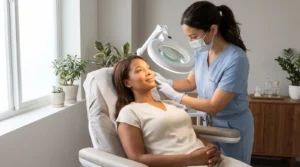
Pigmentation treatment in Mississauga usually means a short series of in-clinic treatments, chemical peels, laser or light therapy, or microneedling, run over about 6 to 12 weeks and matched to the kind of pigment you actually have. For most people it is a few sessions rather than one, paired with daily sun protection and the right topicals at home, and the honest goal is a clearer, more even tone rather than a guaranteed blank slate. What works for you depends mostly on your pigment type, because a flat brown sun spot and a hormonal melasma patch do not respond to the same thing. If you want the clinical overview of the options first, our page on pigmentation treatment at Canada MedLaser lays out the treatments offered across our Mississauga and other GTA clinics.
Pigmentation treatment in Mississauga at a glance
- Common treatments: chemical peels, laser and IPL, microneedling, microdermabrasion, and prescription or cosmeceutical topicals
- Typical course: about 3 to 6 sessions, spaced 2 to 6 weeks apart depending on the treatment
- When results show: early brightening in 1 to 3 weeks, fuller fading over 6 to 12 weeks as skin turns over
- Cost: single treatments commonly run from the low hundreds, and Canada MedLaser’s pigmentation page lists plans starting around $450; the exact quote comes after an assessment
- Melasma is the exception: it is managed rather than cured, and some lasers can make it worse, so gentler options come first
- Sun protection is non-negotiable: daily broad-spectrum SPF is what protects the result and keeps new pigment from forming
- Deeper skin tones: need careful device and setting choices to avoid post-inflammatory darkening
Key terms, defined
- Hyperpigmentation: any area of skin that is darker than your natural tone, from excess melanin
- Melasma: larger, often symmetrical brown or grey-brown patches, usually driven by hormones plus sun and heat
- Post-inflammatory hyperpigmentation (PIH): dark marks left behind after acne, a rash, or irritation
- Solar lentigines: flat sun spots or age spots from cumulative UV exposure
- Melanin: the pigment that gives skin its colour, overproduced in pigmented areas
- Fitzpatrick type: a scale of how skin responds to UV, used to gauge treatment risk
Everyone’s skin is a bit different, so read these ranges as typical rather than a promise. Someone with a few surface sun spots might be thrilled after one or two treatments, while deep or hormonal pigment can take a longer plan and still only fade rather than vanish. Pigmentation treatment is a medical procedure that should be assessed and performed by a trained provider who has actually looked at your skin and history, because the wrong treatment on the wrong pigment can, occasionally, make things worse. The plan you are given in person always takes priority over a general article like this one.
Key Takeaways
- The right pigmentation treatment depends on your pigment type, so the first real step is figuring out whether you are dealing with sun spots, melasma, or post-acne marks.
- Chemical peels, laser and IPL, and microneedling are the main in-clinic options in Mississauga, each suited to slightly different cases.
- Most people need a short series, roughly 3 to 6 sessions, with results building over about 6 to 12 weeks rather than overnight.
- Melasma is a special case: it tends to come back, certain lasers can worsen it, and gentle, consistent management beats aggressive treatment.
- Daily broad-spectrum sunscreen is the single most important habit for keeping pigment from returning after any treatment.
- Darker skin tones can be treated well, but device choice and settings matter more, which is why an experienced provider and a proper consultation are worth seeking out.
What causes pigmentation and dark spots?
Pigmentation and dark spots happen when your skin makes too much melanin in certain areas, and the trigger behind that overproduction is what decides how you treat it. Sun exposure is the big one, since UV light tells your melanocytes to churn out more pigment as a defence, which is why spots pile up on the face, hands and chest over the years. Hormones are another major driver, especially in melasma, and inflammation from acne or irritation leaves its own marks. Knowing which of these you are looking at matters more than people expect, because a treatment that clears sun spots nicely can aggravate melasma.
It helps to sort pigmentation into a few common types, since the labels show up constantly in clinics and in the research. If you want to go deeper on the underlying triggers, our explainer on what causes skin pigmentation covers the mechanisms in more detail.
| Type | What it looks like | Usual cause | How treatable |
|---|---|---|---|
| Sun spots (solar lentigines) | Flat, well-defined brown spots on sun-exposed skin | Cumulative UV exposure over years | Responds well to laser, IPL and peels |
| Melasma | Larger symmetrical brown or grey patches, often on cheeks, forehead, upper lip | Hormones plus UV and heat | Managed, not cured; needs a gentle, patient approach |
| Post-inflammatory hyperpigmentation | Dark marks where a pimple, rash or injury healed | Inflammation, common in deeper skin | Often fades on its own slowly; treatment speeds it up |
| Freckles (ephelides) | Small tan spots that darken in sun | Genetics plus UV | Fade with sun avoidance; laser can lighten |
| Age spots on hands and body | Brown patches on hands, arms, chest and neckline | Long-term sun damage | Respond to laser, IPL and peels |
One quick caution that comes up again and again: if a spot changes shape, colour or size, or a new one looks unusual, that is a question for a doctor rather than a cosmetic clinic, because not every dark spot is harmless pigmentation. A good clinic will flag anything suspicious and send you on for proper assessment rather than treating it.

Which pigmentation treatments actually work?
The treatments that reliably fade pigmentation are chemical peels, laser and IPL, microneedling, and a solid topical routine, usually in combination rather than one alone. Each works a little differently, and the best choice comes down to your pigment type, your skin tone and how much downtime you can take. Here is how the main in-clinic options compare, which is the part most people want to see laid out side by side.
| Treatment | Best for | Downtime | Typical sessions | How it works |
|---|---|---|---|---|
| Chemical peel | Surface sun spots, dullness, mild PIH, some melasma | A few days of flaking | 3 to 6 | Acids exfoliate pigmented surface layers |
| Laser (pigment-targeting) | Defined sun spots and age spots | A few days, sometimes darkening first | 1 to 3 | Light energy breaks up melanin clusters |
| IPL (photofacial) | Diffuse sun damage, freckles, redness | Minimal, spots darken then slough | 3 to 5 | Broad-spectrum light targets pigment and vessels |
| Microneedling | Mild uneven tone, PIH, texture | About 1 to 2 days of redness | 3 to 6 | Micro-channels prompt turnover and renewal |
| Topicals and cosmeceuticals | Maintenance, mild cases, melasma support | None | Ongoing | Slow melanin production and speed turnover |
A fair word of caution on that laser row, because it gets oversimplified. Not every laser suits every pigment, and IPL in particular is usually avoided for melasma because the heat can flare it. This is exactly why a one-size recommendation off a website is risky, and why a provider should assess your skin first. If you would like the broader Canadian picture, our guide to the best treatments for pigmentation in Canada compares these modalities with less of a local lens.
How do chemical peels treat pigmentation?
Chemical peels treat pigmentation by applying exfoliating acids that lift away the pigmented top layers of skin and nudge fresh, more even skin to the surface. Depending on the strength, a peel might use glycolic, lactic, mandelic, salicylic or trichloroacetic acid, and lighter peels are often chosen for pigmentation because they carry less risk of irritation that could, ironically, leave more marks. You usually feel a bit of tingling during, then some flaking over the next few days.
Peels are a workhorse for surface pigmentation, and they pair well with a good home routine. For melasma, gentler peels can be part of the plan, though they are rarely a standalone fix. Mandelic and lactic acid peels tend to be favoured for darker skin because they are less likely to trigger post-inflammatory darkening. If you want the full rundown, our chemical peels guide walks through the types and what to expect, and we have a specific piece on chemical peels for melasma as well. There is also a herbal option, the Green Peel, that some people prefer for a more natural approach.
How does laser treatment fade dark spots?
Laser treatment fades dark spots by delivering targeted light energy that is absorbed by the melanin in a spot, shattering the pigment into tiny particles your body then clears away. For a flat, well-defined sun spot, this can work impressively fast, sometimes in one or two sessions, with the spot often darkening briefly before it flakes off. Pigment-selective lasers and some picosecond devices are the usual tools here.
The important caveat is melasma and deeper skin tones. Melasma sits deeper and is heat-sensitive, so aggressive laser or IPL can scatter pigment further or spark a rebound, which is the opposite of what you want. In richer skin tones, the wrong wavelength or setting can cause post-inflammatory hyperpigmentation. None of this means laser is off the table, it just means the device, the settings and the provider’s experience matter a lot more than the marketing. Our article on telling hyperpigmentation and melasma apart is worth a read before you assume laser is the answer, and our broader piece on how to get rid of dark spots on your face covers where laser fits alongside everything else.
Can microneedling help with pigmentation?
Microneedling can help with mild pigmentation and post-acne marks by speeding up skin turnover and encouraging surface pigment to shed, and it tends to be gentler on deeper skin than heat-based lasers. Fine needles create controlled micro-channels that kick off the skin’s repair response, which refreshes tone and texture together. On its own it is rarely a dramatic pigment eraser, but as part of a plan with sunscreen and the right actives, it earns its place.
Because it relies on physical micro-injury rather than light energy, microneedling is often considered a reasonable option across a wide range of skin tones, though careful technique still matters since any inflammation carries some risk of darkening. If you are curious about the treatment itself, our overview of microneedling at Canada MedLaser explains how a session works, and we have a local cost breakdown for microneedling in Mississauga if you are weighing it up. It also folds neatly into a wider skin rejuvenation plan when tone is not your only concern.
What about topical treatments and prescriptions?
Topical treatments are the foundation under every in-clinic pigmentation plan, and for mild cases they can be enough on their own with time and patience. The active ingredients work in two broad ways: some slow down melanin production, others speed up how fast pigmented cells shed. Most dermatologists would say the single most important product is not a brightener at all, it is sunscreen, because without daily protection you are constantly refilling the pigment you are trying to clear.
| Ingredient | What it does | Good to know |
|---|---|---|
| Broad-spectrum SPF | Blocks the UV that triggers and darkens pigment | Daily, rain or shine; tinted with iron oxide helps melasma |
| Vitamin C | Antioxidant that brightens and helps prevent new spots | Pairs well with sunscreen in the morning |
| Niacinamide | Calms skin and limits pigment transfer | Gentle, suits most skin types |
| Azelaic acid | Fades post-blemish marks and reduces inflammation | A good choice when acne and pigment overlap |
| Alpha arbutin and kojic acid | Inhibit the enzyme that makes melanin | Gentler brighteners, often combined |
| Retinoids | Speed cell turnover to shed pigmented cells | Introduce slowly; avoid in pregnancy |
| Hydroquinone | Strong pigment-suppressor, very effective short term | Higher strengths are prescription in Canada; misuse can cause rebound darkening |
A caution on hydroquinone, since it comes up a lot online. It genuinely works, but it is meant for supervised, time-limited use, and overusing it can trigger rebound hyperpigmentation that is harder to treat than what you started with. That is the kind of thing a provider helps you navigate. For a plain-language tour of the home options, our piece on how to get rid of skin pigmentation is a sensible starting point.
How is melasma treated differently?
Melasma is treated as a chronic, relapsing condition rather than a one-and-done fix, which is the single most important thing to understand about it. It is driven by a mix of hormones, UV and heat, so it tends to improve with consistent care and then flare again with sun, pregnancy or certain medications. The goal is control and fading, not a permanent cure, and setting that expectation up front saves a lot of disappointment.
Because melasma is heat-sensitive, the gentler end of the toolkit comes first: diligent sun protection including visible-light cover, topical brighteners, and mild peels, with any laser used cautiously and selectively by someone who knows the risks. Aggressive treatment can backfire and make it darker, which is why melasma really rewards an experienced hand. Our dedicated guide on what melasma is and how it is treated goes further into the day-to-day management, and it is worth reading if you suspect those symmetrical cheek patches are melasma rather than ordinary sun spots.
Is pigmentation treatment safe for darker skin tones?
Pigmentation treatment is safe and effective for darker skin tones, but the margin for error is smaller, so provider experience and the right technology matter more. The main concern in richer skin, Fitzpatrick types IV to VI, is post-inflammatory hyperpigmentation, where the treatment itself provokes new darkening if it causes too much heat or irritation. The solution is not to avoid treatment, it is to choose approaches and settings that respect the skin.
In practice that often means favouring gentler peels like mandelic or lactic acid, microneedling over heat-heavy lasers in some cases, and specific laser wavelengths handled conservatively. A careful provider will also start low and build, and will insist on sun protection and sometimes a priming routine beforehand. If a clinic treats every skin tone the same way with the same settings, that is a reasonable red flag. This is one area where asking about experience with your skin tone is completely fair, and a good clinic will welcome the question.
How much does pigmentation treatment cost in Mississauga?
Pigmentation treatment in Mississauga typically runs from the low hundreds per session for peels and microneedling up to several hundred for laser, with full plans often landing in the high hundreds to low thousands once you account for a series. Canada MedLaser’s own pigmentation page lists treatment plans starting around $450, though the real number depends on which treatment suits you, how many sessions you need, and the size of the area. Pricing for a single spot is very different from treating a full face of melasma.
| Treatment | Typical range per session | Notes |
|---|---|---|
| Chemical peel | Low hundreds | Lighter peels cost less; a course is usually recommended |
| Microneedling | Low to mid hundreds | Often sold as a package of several sessions |
| Laser or IPL for pigment | Mid to high hundreds | Varies with area size and number of spots |
| Full pigmentation plan | High hundreds to low thousands | Combines treatments and maintenance over months |
These are general GTA ranges to set expectations, not a quote, and they shift over time. The only way to get a real figure is an assessment, because the plan is built around your pigment, not a menu price. Our breakdown of the cost, procedure and risks of pigmentation treatment digs into what drives the price if you want to understand the variables before you book.
How many sessions and how long until you see results?
Most pigmentation plans run about 3 to 6 sessions, and you will usually see early brightening within a couple of weeks and fuller fading over roughly 6 to 12 weeks. The exact timeline depends on the treatment and the depth of the pigment, since surface sun spots clear faster than deep or hormonal pigment. Laser on a defined spot can look dramatic quickly, while melasma asks for patience measured in months.
| Timeframe | What you will usually notice |
|---|---|
| First few days | Treated spots may darken, flake or feel like a mild sunburn, then settle |
| Week 1 to 3 | Early brightening and a fresher, more even surface |
| Week 4 to 8 | Spots lightening more clearly as skin turns over, often between sessions |
| Week 8 to 12 | Fuller results from a completed series, tone looking more even |
| Ongoing | Maintenance and sun protection to hold the result and prevent recurrence |
The part people underestimate is maintenance. Pigment, especially melasma and sun-driven spots, can creep back without ongoing sun protection and the occasional touch-up, so the smart way to think about it is a result you protect rather than a finish line you cross once.
How do you choose a pigmentation clinic in Mississauga?
Choosing a pigmentation clinic in Mississauga comes down to a proper assessment, the right range of treatments, and real experience with your skin type, rather than the lowest advertised price on its own. Pigmentation is one of those concerns where the wrong treatment can set you back, so the consultation itself tells you a lot. A clinic that looks closely at your skin, asks about your history and hormones, and explains why it is recommending one approach over another is doing the job right.
A few things worth checking: that treatments are performed by trained medical aesthetic providers under appropriate oversight, that the clinic offers more than one modality so it can match the treatment to your pigment rather than fitting you to the one machine it owns, and that it is honest about melasma being manageable rather than curable. It also helps if the clinic is genuinely local, since a short series means several visits. Canada MedLaser runs a Mississauga clinic alongside other GTA locations, and you can read a bit about the local skin side of things in our piece on skin rejuvenation in Mississauga.
How do you prepare and protect your skin after treatment?
Preparing for pigmentation treatment is mostly about calm, sun-protected skin and pausing anything irritating, while aftercare is mostly about protecting the result from UV. Clinics often ask you to avoid sun and tanning in the weeks beforehand, pause retinoids and strong acids for a few days, and sometimes prime the skin with a brightening routine, particularly for melasma or deeper skin tones. Showing up with a sunburn is the quickest way to have a treatment postponed.
Afterward, the skin is more vulnerable to UV, so sunscreen moves from helpful to essential. Keep the area clean and gently moisturized, skip harsh actives for a few days, let any darkened spots flake off on their own rather than picking, and stay out of strong heat and direct sun. This is the stretch where results are either locked in or undone, and honestly, the people who get the best outcomes are usually the ones who take the sun protection seriously. Your provider’s specific instructions always beat a general list.

Pigmentation treatment at Canada MedLaser in Mississauga
Every pigmentation plan at Canada MedLaser starts with a consultation, because the right treatment depends entirely on your pigment type, your skin tone and your history, and getting that wrong is how people end up frustrated. That assessment is where a provider works out whether a peel, a laser, microneedling, a topical routine, or some combination makes the most sense for you, and whether what you are seeing is straightforward sun damage or something like melasma that needs a gentler long game. If you are in the area, you can book a consultation at our Mississauga clinic and bring your questions along.
It also helps to read around the subject, since the treatments overlap with other skin concerns. Our overview of pigmentation treatment options is the natural next stop, and the related reading below covers the specific pieces, melasma, dark spots, peels and microneedling, in more depth.
Frequently asked questions about pigmentation treatment in Mississauga
What is the best treatment for pigmentation in Mississauga?
There is no single best treatment, it depends on your pigment type. Surface sun spots respond well to laser and peels, melasma needs a gentle, patient approach led by topicals and sun protection, and post-acne marks often do well with microneedling or azelaic acid. A consultation is what matches the treatment to your skin.
How much does pigmentation treatment cost in Mississauga?
Single treatments commonly run from the low hundreds for peels and microneedling up to several hundred for laser, and Canada MedLaser’s pigmentation page lists plans starting around $450. The real figure depends on the treatment, the number of sessions and the area, so it is quoted after an assessment.
Can pigmentation be removed permanently?
Some pigmentation, like isolated sun spots, can be cleared and stay gone with good sun protection, but no honest clinic promises permanent removal across the board. Melasma in particular tends to return, so the realistic goal is significant fading plus ongoing maintenance rather than a permanent cure.
What causes pigmentation on the face?
Most facial pigmentation comes from sun exposure, hormones, or inflammation after acne or irritation. UV light is the biggest driver because it tells skin to make more melanin, which is why spots cluster on the face and why daily sunscreen matters so much.
Which is better for pigmentation, laser or chemical peel?
Neither is universally better. Laser is excellent for defined, flat sun spots and can work fast, while peels suit broader surface dullness and mild, widespread pigment. For melasma and deeper skin tones, gentler peels are often safer than aggressive laser. The right pick depends on your case.
Is laser safe for melasma?
Laser can be used for melasma but only cautiously and selectively, because melasma is heat-sensitive and aggressive treatment can make it darker. IPL in particular is usually avoided. Many providers lead with sun protection and topicals first, reserving careful laser for specific situations.
How many sessions do I need to fade dark spots?
Most people need about 3 to 6 sessions, though a single defined sun spot sometimes clears in one or two laser treatments. Deeper or hormonal pigment usually needs a longer series, and results build over weeks rather than appearing right after one visit.
Does pigmentation come back after treatment?
It can, especially sun-driven spots and melasma, if you are not protecting your skin from UV. This is why sunscreen and maintenance are part of every sensible plan. Treatment clears what is there, but your habits decide how long it stays clear.
Is pigmentation treatment safe for brown and dark skin?
Yes, when the provider chooses the right approach and settings. The main risk in deeper skin is post-inflammatory darkening from too much heat or irritation, so gentler peels, microneedling and carefully handled lasers are often favoured. Experience with your skin tone is worth asking about directly.
What is the difference between hyperpigmentation and melasma?
Hyperpigmentation is the umbrella term for any darkened skin, while melasma is a specific type driven largely by hormones and worsened by sun and heat. Melasma is usually larger, symmetrical and more stubborn, and it is managed rather than cured, which affects how it is treated.
Which cream is best for hyperpigmentation?
There is no single best cream, but effective ingredients include vitamin C, niacinamide, azelaic acid, alpha arbutin, kojic acid and retinoids, with prescription hydroquinone for supervised short-term use. Daily sunscreen is arguably the most important product of all. A provider can match ingredients to your skin.
How long does it take to see results?
Many people notice early brightening within one to three weeks, with fuller fading over roughly 6 to 12 weeks as the skin turns over and a series is completed. Melasma and deep pigment take longer and ask for patience measured in months.
Does microneedling help with dark spots?
Microneedling can help with mild dark spots and post-acne marks by speeding skin turnover, and it is gentler on deeper skin than heat-based lasers. It is usually most effective as part of a plan with sunscreen and brightening actives rather than entirely on its own.
What fades dark spots the fastest?
For a single, defined sun spot, targeted laser is often the fastest route, sometimes visibly fading it in one or two sessions. For widespread or hormonal pigment there is no quick fix, and chasing speed with aggressive treatment can backfire, especially with melasma.
Can I treat pigmentation at home?
Mild surface pigmentation can improve with a consistent home routine of sunscreen, vitamin C, niacinamide and a gentle brightener, given time. Stubborn, deep or hormonal pigment usually needs in-clinic treatment, and strong products like prescription hydroquinone should be used under guidance to avoid rebound darkening.
Is hydroquinone available over the counter in Canada?
Lower-strength formulas appear in some cosmetic products, but higher-strength hydroquinone is prescription in Canada and meant for supervised, time-limited use. It is effective but can cause rebound hyperpigmentation if overused, which is why professional guidance is sensible.
Do I need a consultation before pigmentation treatment?
Yes, a consultation is important because the right treatment depends on identifying your pigment type and skin tone, and the wrong approach can worsen certain pigmentation. The assessment is where a provider rules out anything concerning and builds a plan suited to your skin.
Is pigmentation treatment painful?
Most pigmentation treatments are quite tolerable. Peels cause tingling, laser feels like small snaps often eased with cooling, and microneedling is done after numbing cream. Any discomfort is usually brief, and your provider can adjust for comfort during the session.
Expert Insight
After seeing a lot of pigmentation cases come through, the pattern that stands out is how often the first mistake is treating the pigment before identifying it.
The honest advice I give is to spend the time getting the diagnosis right before you spend money on treatment. Sun spots and melasma can look similar in the mirror but they want opposite things, one tolerates a confident laser, the other punishes it. So start with an assessment, protect your skin from the sun like it is the treatment itself, because in many ways it is, and be patient with a short series rather than chasing an overnight result that pigmentation rarely gives.
Related Reading
- Pigmentation treatment options at Canada MedLaser
- Hyperpigmentation vs melasma: how to tell them apart
- Melasma: what it is and how it is treated
- How to get rid of dark spots on your face
- Chemical peels: types, benefits and what to expect
- The best treatments for pigmentation in Canada
- Microneedling in Mississauga: cost and sessions
- Pigmentation treatment: cost, procedure and risks
Conclusion
Pigmentation treatment in Mississauga works best when it starts with the right diagnosis and a realistic plan: peels, laser, microneedling and topicals all have a place, but which one helps you depends on whether you are dealing with sun spots, melasma or post-acne marks. Most people see real improvement over a short series of 6 to 12 weeks, and the ones who hold onto their results are the ones who treat daily sun protection as part of the treatment rather than an afterthought.
If you are not sure what kind of pigmentation you have or which route makes sense, the sensible next step is a consultation with a provider who can look at your skin first, flag anything that needs a doctor, and map a plan from there. Bring your history and your questions, and let the assessment lead.
This article is general education and not a substitute for personalized medical advice. Candidacy, treatment choice, number of sessions and suitability require assessment by a qualified professional who knows your medical history and skin type. Pigmentation treatment is not guaranteed, permanent, painless or risk-free, individual results vary, and any prices or timelines referenced are typical ranges that change over time. For general skin health information, see the Canadian Dermatology Association and the American Academy of Dermatology’s guidance on fading dark spots.
Trust our skin and laser guides? Add Canada MedLaser as a preferred source on Google.