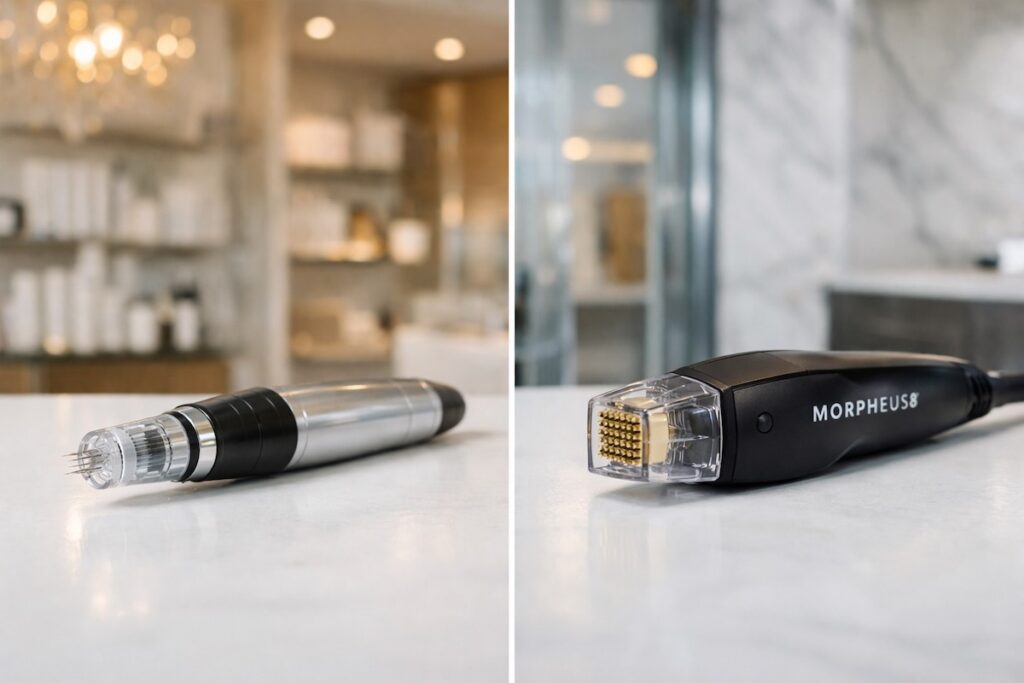
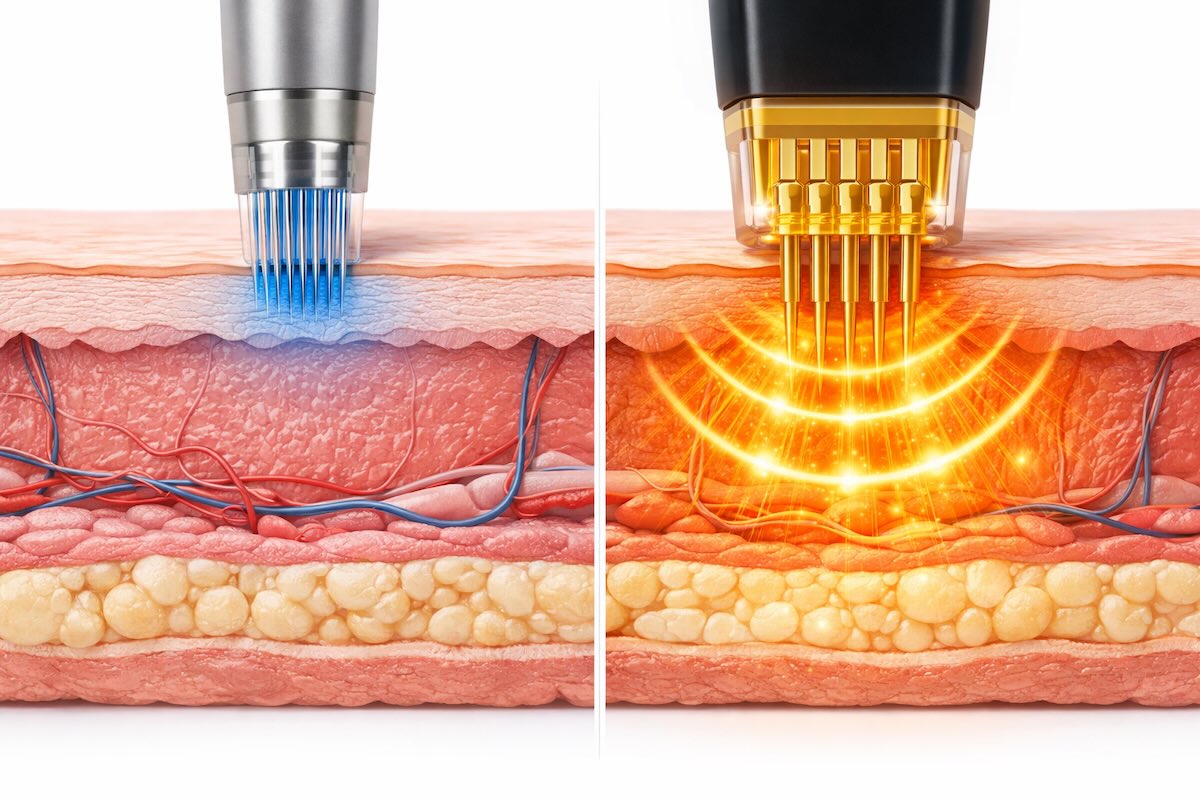
Microneedling and Morpheus8 both stimulate collagen, but they work at very different depths. Microneedling uses fine needles to create micro-injuries up to about 2.5 mm into the skin, while Morpheus8 combines microneedling with radiofrequency energy and reaches up to 7 to 8 mm. Microneedling suits surface concerns like fine lines and texture. Morpheus8 is better for sagging skin, deeper scars, and tightening. If you want the gentler option explained end to end, our guide to microneedling before and after results walks through the realistic timeline.
If budget is part of the decision, see our breakdown of Morpheus8 cost in Toronto and the GTA, including how per-session prices compare with traditional microneedling.
Key Takeaways
- Morpheus8 is not simply “better” microneedling; it is a different category of treatment with a different mechanism, higher cost, and longer recovery.
- Microneedling is the smarter starting point for patients in their late 20s to mid-30s with surface concerns, tighter budgets, or no significant skin laxity.
- Morpheus8 outperforms microneedling for moderate to severe acne scars, jowling, neck laxity, and any concern requiring deep tissue remodeling.
- Sessions required differ significantly: microneedling typically needs 4 to 6 sessions; Morpheus8 usually delivers results in 1 to 3.
- Toronto pricing: microneedling runs $250 to $600 per session; Morpheus8 ranges from $1,000 to $2,500 per session depending on the area treated.
- Both treatments are safe for darker skin tones because RF energy is not chromophore-dependent, unlike many laser treatments.
- Combining both across a treatment plan is common and often produces the best long-term outcomes.
- Downtime is a real differentiator: microneedling means 1 to 2 days of redness; Morpheus8 can mean 5 to 7 days of noticeable swelling and redness.
- Results last longer with Morpheus8: 1 to 2 years versus 6 to 12 months for standard microneedling.
- A proper in-person skin assessment is the only reliable way to determine which treatment fits your specific concern.
When Toronto patients start researching the microneedling vs Morpheus8 question, they often assume one is simply a stronger version of the other. That framing is understandable but a little misleading, and it leads people to either overspend on a treatment they don’t need or undershoot on one that won’t address their actual concern. This article breaks down both treatments honestly, covering how they work, what they’re genuinely good at, what they cost in Toronto in 2026, and who should choose which one first.
What Is Microneedling?
Microneedling is a collagen induction therapy that uses a motorized pen device fitted with a cluster of very fine needles. The device moves rapidly across the skin, creating thousands of controlled micro-channels in the epidermis and upper dermis. These micro-injuries trigger the skin’s natural wound healing response, which includes the release of growth factors and the production of new collagen and elastin.
The depth of penetration is adjustable, typically ranging from 0.25 mm to 2.5 mm, and practitioners vary the setting depending on the treatment area and the concern being addressed. Delicate areas like the under-eye zone are treated at shallower depths; thicker skin on the cheeks or forehead can tolerate deeper settings.
Microneedling works well for:
- Superficial fine lines and early wrinkles
- Uneven skin texture and rough patches
- Enlarged pores
- Mild to moderate acne scarring (rolling scars especially)
- Light hyperpigmentation and uneven tone
- General skin dullness and early signs of aging
Results from microneedling are gradual. The skin continues producing collagen for several weeks after each session, and most patients see meaningful improvement after a series of 4 to 6 treatments spaced 4 to 6 weeks apart.
One thing worth knowing: microneedling pairs well with add-ons. PRP microneedling uses platelet-rich plasma drawn from the patient’s own blood to amplify the healing response. Exosome therapy is another option that’s gaining traction in Toronto clinics for patients who want accelerated recovery and enhanced collagen output without committing to a more intensive treatment.
All reputable Toronto clinics use medical-grade devices, and the treatment should always be performed by a trained practitioner, not an esthetician working outside their regulated scope.
What Is Morpheus8?
Morpheus8 is a fractional radiofrequency microneedling device manufactured by InMode. It is not a laser. It is not a standard microneedling pen. It combines both technologies: an array of 24 gold-coated microneedles that penetrate the skin and deliver bipolar radiofrequency energy directly into the deeper dermis and subcutaneous tissue.
This dual mechanism is what makes Morpheus8 fundamentally different. The needles create the micro-channels, and the RF energy heats the tissue at the tip of each needle, causing immediate collagen contraction and triggering sustained new collagen production that continues for 3 to 6 months after the treatment. The depth is programmable from 1 mm to 7 or 8 mm, and with the thermal spread of the RF energy, the effective treatment depth can reach even deeper.
Because it uses fractional technology, Morpheus8 targets small zones of tissue while leaving surrounding areas intact. This speeds up healing compared to ablative treatments that affect the entire surface uniformly.
A note on terminology: Morpheus8 is a brand name. The category it belongs to is RF microneedling. Other devices exist in this category, but Morpheus8 is the most widely used and studied version in Canadian clinics. When people ask about “RF microneedling vs microneedling,” they are essentially asking the same question as microneedling vs Morpheus8.
The customization available with Morpheus8 is also worth noting. Practitioners can independently program energy levels, needle depth, burst duration, and coagulation mode for different zones of the face or body. That means a single session can address multiple concerns at different depths simultaneously, which is something a standard microneedling pen simply cannot do.
For a full overview of what the Morpheus8 treatment in Toronto involves, including device specs and protocol details, that page covers it thoroughly.
Microneedling vs Morpheus8 at a Glance
This is the core comparison. For most patients, this table answers the majority of their questions before they even book a consultation.
| Feature | Microneedling | Morpheus8 |
|---|---|---|
| Technology | Fine needles only | Fine needles plus radiofrequency energy |
| Depth of penetration | 0.25 to 2.5 mm | Up to 7 to 8 mm |
| Best for | Texture, fine lines, mild acne scars, large pores | Skin laxity, deeper wrinkles, moderate to severe scars, body contouring |
| Treatment areas | Face, neck, décolletage | Face, neck, jawline, abdomen, arms, thighs, knees |
| Sessions for results | 4 to 6 | 1 to 3 |
| Spacing between sessions | 4 to 6 weeks | 4 to 6 weeks |
| Downtime | 24 to 48 hours of mild redness | 5 to 7 days of redness and swelling |
| Pain level | Mild with topical numbing | Moderate, similar to laser hair removal |
| Results timeline | Visible at 4 to 6 weeks, full results in 3 months | Initial tightening within days, full results in 3 to 6 months |
| How long results last | 6 to 12 months with maintenance | 1 to 2 years |
| Toronto cost per session | $250 to $600 | $1,000 to $2,500 |
| Safe for darker skin tones | Yes | Yes (RF energy is colour-blind, unlike many lasers) |
The two most important takeaways from this table: Morpheus8 requires far fewer sessions to achieve results, but each session costs significantly more and demands more recovery time. For patients with surface-level concerns and no significant laxity, microneedling often delivers a better cost-per-result ratio. For patients dealing with sagging skin, deep scarring, or body areas, Morpheus8 is the more appropriate tool.
Which Treatment Is Better for Acne Scars?
For acne scars, the right answer depends on scar type and severity. Microneedling handles shallow rolling scars and general texture irregularity reasonably well. A series of 4 to 6 sessions can produce visible softening of these surface-level scars, particularly when combined with PRP or exosomes to accelerate tissue remodeling.
Boxcar scars and ice pick scars are a different story. These scar types involve fibrotic tissue that sits deeper in the dermis, and standard microneedling needles simply don’t reach that depth consistently. Morpheus8, with its ability to penetrate to 7 or 8 mm and deliver RF energy precisely into the scar tissue, remodels that fibrotic tissue at the foundational level. The thermal energy disrupts the fibrous bands that tether the scar down, allowing the skin to lift and smooth over subsequent weeks.
For moderate to severe acne scarring, Morpheus8 is the more effective single treatment. That said, many Toronto clinics build acne scar treatment plans that start with microneedling to improve surface texture and overall skin quality, then introduce Morpheus8 for the deeper structural work. This staged approach can also be more budget-friendly than jumping straight into multiple Morpheus8 sessions. For a scar-focused look at the RF option, see our guide to Morpheus8 for acne scars.
If anti-aging and scar correction are both on the list, that combination protocol often makes the most clinical sense.
Which Treatment Is Better for Sagging Skin and Fine Lines?
Morpheus8 wins this comparison clearly, and it’s not particularly close. The RF energy in Morpheus8 causes immediate thermal contraction of existing collagen fibres the moment it’s delivered. Patients sometimes notice a subtle tightening effect within days of treatment, before the longer-term collagen remodeling even begins. That remodeling then continues for 3 to 6 months, producing progressive improvements in firmness and definition.
Standard microneedling does not generate the tissue contraction necessary to produce visible lifting of sagging areas. The collagen it stimulates is real and beneficial, but it works at the surface level and cannot address the structural laxity that develops in the deeper dermis and subcutaneous tissue as skin ages.
Common Morpheus8 treatment areas for laxity:
- Jowls and jawline definition
- Neck skin laxity (“tech neck” and general crepiness)
- Under-eye area and lower eyelid laxity
- Nasolabial folds and marionette lines
- Knees and inner thighs
- Post-weight-loss or postpartum skin on the abdomen
For patients in their late 30s and beyond who are noticing the early signs of jowling or neck laxity, Morpheus8 is often the first recommendation from experienced practitioners. Microneedling at that stage is not the wrong choice, but it’s unlikely to address the structural concern driving the visible change.
Fine lines around the eyes and mouth are a slightly different case. Superficial lines respond well to microneedling, and the cost-to-benefit ratio is better for that specific concern. Deeper wrinkles with a structural component benefit more from Morpheus8. If fine lines and wrinkles are the primary concern, the depth and severity of those lines should guide the choice.
Which Treatment Is Better for Texture, Pores, and Surface Concerns?
For surface-level concerns, microneedling is often the smarter choice. Enlarged pores, uneven texture, mild hyperpigmentation, and general dullness all sit in the upper layers of the skin, and microneedling addresses those layers directly without the added cost and downtime of a deeper treatment.
This is perhaps the clearest case where Morpheus8 is not automatically the better option. Spending $1,500 or more per session to treat a concern that sits at 0.5 mm depth is, frankly, more than the problem requires. Microneedling at $300 to $400 per session, across a series of treatments, will produce excellent results for texture and pore concerns with significantly less recovery time.
Adding PRP or exosomes to a microneedling session amplifies the results without requiring the jump to RF microneedling. For patients dealing with enlarged pores or pigmentation concerns, this combination often delivers the improvement they’re looking for at a fraction of the Morpheus8 cost.
The one exception worth noting: if a patient has both surface texture concerns and underlying laxity, Morpheus8 can address both in the same session because of its programmable depth settings. In that scenario, the higher cost becomes more justifiable.
How Much Do Microneedling and Morpheus8 Cost in Toronto?
Toronto pricing for both treatments varies depending on the clinic, the area being treated, and whether add-ons like PRP or exosomes are included.
Microneedling in Toronto:
- Per session: $250 to $600
- Most clinics fall in the $300 to $400 range for a full face
- Package pricing (typically 3 to 6 sessions) usually brings the per-session cost down by 10 to 20 percent
Morpheus8 in Toronto:
- Per session: $1,000 to $2,500
- Full face and neck packages tend to sit at the higher end of that range
- Smaller treatment areas (under eyes only, for example) may come in closer to $800 to $1,200
- Adding exosomes or PRP typically adds $300 to $600 per session
A few things worth knowing about pricing. First, package deals at reputable Toronto clinics can make Morpheus8 more accessible than the per-session price suggests. Second, the total cost of a microneedling series (say, 5 sessions at $350 each) is $1,750, which is comparable to a single Morpheus8 session. Over a 12-month period, the total investment for each approach can end up being similar, but the results and maintenance schedule differ.
Third, and this is worth saying plainly: very low prices for either treatment are a warning sign. Morpheus8 sessions advertised at $400 or $500 in Toronto almost certainly involve undertrained operators, older or non-genuine devices, or inadequate energy settings that won’t produce clinical results. Price is not always a reliable quality signal, but unusually low pricing for a capital-intensive treatment like Morpheus8 should prompt questions.
Can You Combine Microneedling and Morpheus8?
Yes, and many Toronto patients do exactly this. The two treatments are complementary rather than competing, and a thoughtful combination protocol often produces better long-term skin quality than either treatment alone.
A common approach is to start with a series of microneedling sessions to improve overall skin health, texture, and tone. Once the skin is in good condition, Morpheus8 is introduced once or twice a year to address deeper structural concerns like laxity or stubborn scarring. Some patients maintain this rhythm indefinitely: microneedling every few months for surface upkeep, Morpheus8 annually for structural maintenance.
Some clinics also layer exosomes or PRP on top of either treatment to enhance healing and amplify collagen output. This is particularly popular with Morpheus8, where the micro-channels created by the needles allow topical actives to penetrate much more deeply than they would on intact skin.
One important caution: do not schedule microneedling and Morpheus8 too close together. The skin needs adequate time to heal between sessions of either treatment, and layering two collagen-stimulating treatments within a short window can cause unnecessary inflammation without producing better results. Most practitioners recommend waiting at least 4 to 6 weeks between any two collagen-stimulating treatments.
Pain, Recovery, and Aftercare
Being honest about what each treatment feels like is useful, because the experience differs more than most clinic websites acknowledge.
Microneedling: With topical numbing cream applied 30 to 45 minutes before treatment, most patients describe the sensation as a mild scratching or prickling, similar to a rough exfoliation. It’s generally well-tolerated. Immediately after, the skin looks red and feels tight, similar to a mild sunburn. That redness typically resolves within 24 to 48 hours, and most patients return to normal activities the next day.
Morpheus8: Also performed with topical numbing cream, but the experience is more intense. The deeper needle penetration and the heat from the RF energy create a sensation that’s often compared to laser hair removal, with feelings of pressure and warmth throughout the session. Some patients find the neck area particularly uncomfortable. After treatment, redness and swelling are more pronounced and can persist for 5 to 7 days. Pinpoint scabbing at the needle entry points is normal and should not be picked.
Post-treatment care for both:
- Avoid direct sun exposure for at least 2 weeks and use SPF 30 or higher daily
- Skip active skincare ingredients (retinol, AHAs, BHAs, vitamin C) for 48 to 72 hours post-treatment
- Use gentle, fragrance-free moisturizer and a mild cleanser during the healing period
- Avoid saunas, hot showers, and intense exercise for 48 hours
- Do not apply makeup for at least 24 hours after microneedling; wait 48 to 72 hours after Morpheus8
Who Should Choose Microneedling First?
Microneedling is generally the right starting point for patients who fit the following profile:
- Age range: Late 20s to mid-30s, with no significant skin laxity
- Primary concerns: Texture, mild acne scars, enlarged pores, early fine lines, or general skin dullness
- Budget: Looking for meaningful results without committing to a $1,000-plus per session treatment
- Downtime tolerance: Needs to return to work or social activities within 1 to 2 days
- Skin journey stage: Just beginning to invest in professional skin treatments and wants to understand how their skin responds before escalating
Microneedling is also a sensible choice for patients who’ve been told they’re “not quite there yet” for Morpheus8 by an honest practitioner. Some clinics push Morpheus8 on every patient because the margin is better. An experienced injector or aesthetician who recommends microneedling first for a 29-year-old with mild texture concerns is giving genuinely good advice, not underselling.
You can explore microneedling in Toronto for more detail on what a session involves and what to expect from a full treatment series. If you are west of the city, our guide to microneedling in Burlington covers local pricing, session counts and provider questions for the Halton area. And if you are north of the city, our guide to Morpheus8 in Vaughan covers cost, sessions and what to expect locally.
Who Should Choose Morpheus8 First?
Morpheus8 is the better starting point for patients dealing with:
- Skin laxity: Jowling, neck looseness, or sagging in any area that microneedling cannot address
- Moderate to severe acne scars: Particularly boxcar or ice pick scars that sit deep in the dermis
- Age range: Generally late 30s and above, though younger patients with significant scarring may also benefit
- Body concerns: Small areas of skin laxity on the abdomen, inner thighs, knees, or arms where non-surgical tightening is the goal
- Postpartum patients: Skin that lost elasticity during pregnancy and hasn’t responded to surface-level treatments
- Efficiency: Patients who want meaningful results in fewer sessions and are willing to invest more upfront and accept more downtime
Morpheus8 is also worth considering for patients who’ve already completed a full microneedling series and want to take their results further. At that point, the skin has been primed and the next logical step is deeper remodeling.
For those exploring Morpheus8 in Toronto, the treatment page covers candidacy, session protocols, and what the recovery period looks like in more detail.
Booking a Consultation in Toronto
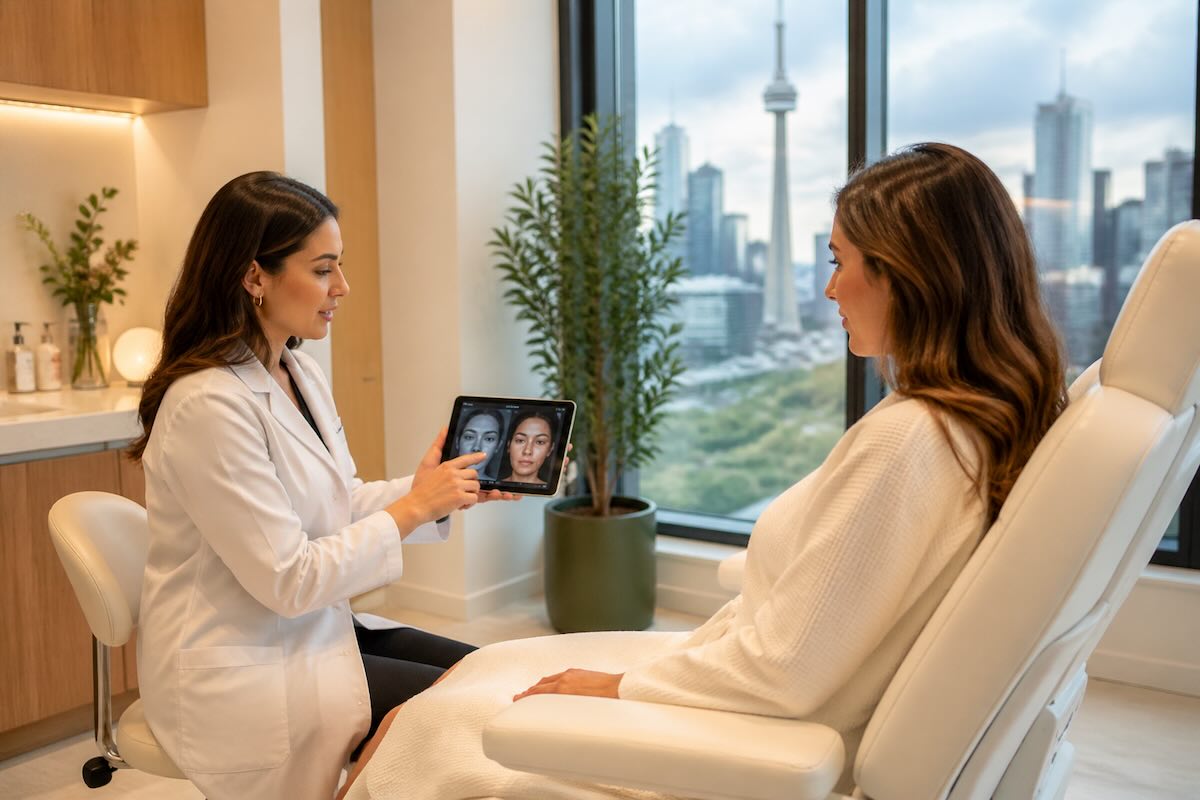
The comparison above covers a lot of ground, but the honest answer to “which treatment is right for me” requires seeing your skin in person. Photographs help, but they don’t replace a proper assessment of skin texture, laxity, scar depth, and overall skin health.
The most reliable approach is to book a consultation at a Toronto clinic that offers both treatments and has practitioners experienced with both. That way the recommendation is based on what your skin actually needs, not on which device the clinic happens to have available.
Canada MedLaser Toronto offers both microneedling and Morpheus8, along with a range of complementary skin treatments in Toronto for patients whose concerns span multiple categories. A Toronto consultation is a practical first step for anyone still weighing their options.
Frequently Asked Questions
Is Morpheus8 just an expensive version of microneedling?
No. Morpheus8 is a different category of treatment. Standard microneedling works mechanically at the surface level; Morpheus8 adds radiofrequency energy that heats tissue at depths of up to 7 to 8 mm. The mechanisms, results, and appropriate use cases are genuinely different, not just a matter of intensity.
Does Morpheus8 hurt more than microneedling?
Yes, generally. Both use topical numbing cream, but Morpheus8’s deeper needle penetration and RF heat create a more intense sensation, often compared to laser hair removal. Microneedling with numbing is typically described as mild scratching or prickling. Most patients tolerate both, but Morpheus8 requires more mental preparation.
How many sessions of Morpheus8 vs microneedling do I need?
Microneedling typically requires 4 to 6 sessions spaced 4 to 6 weeks apart for substantial improvement. Morpheus8 usually delivers visible results after 1 to 2 sessions, with most treatment plans involving 1 to 3 sessions total. Morpheus8 results also last longer, reducing the frequency of maintenance treatments.
Can microneedling tighten skin like Morpheus8?
Not to the same degree. Microneedling stimulates collagen at the surface level, which can produce modest improvements in skin firmness over time. It cannot generate the tissue contraction that RF energy produces in the deeper dermis. For meaningful tightening of sagging areas, Morpheus8 is the more appropriate treatment.
Is Morpheus8 safe for darker skin tones?
Yes. RF energy is not chromophore-dependent, meaning it doesn’t target melanin the way many laser treatments do. This makes Morpheus8 a suitable option for patients with Fitzpatrick skin types IV through VI, who may be poor candidates for certain laser resurfacing treatments. A qualified practitioner should still adjust settings appropriately for each patient.
How soon will I see results from each treatment?
With microneedling, most patients notice improved texture and glow within 2 to 4 weeks of their first session, with cumulative results building over the treatment series. With Morpheus8, some tightening is visible within days due to immediate collagen contraction, and full results continue developing over 3 to 6 months as new collagen matures.
Can I do microneedling and Morpheus8 in the same week?
No. Both treatments stimulate collagen and create controlled injury to the skin. Doing them within the same week would cause excessive inflammation without producing better results. Most practitioners recommend waiting at least 4 to 6 weeks between any two collagen-stimulating treatments.
Is one better for under-eye bags or under-eye laxity?
For under-eye laxity and crepiness, Morpheus8 is generally more effective because it can address the structural looseness in the tissue. Standard microneedling can improve surface texture in the under-eye area but won’t produce meaningful lifting. Both treatments require careful technique in this delicate zone, and not all clinics offer under-eye Morpheus8, so it’s worth asking specifically.
Conclusion
The microneedling vs Morpheus8 question doesn’t have a universal answer, and anyone who tells you one treatment is always better than the other is probably oversimplifying. What matters is matching the treatment to the actual concern.
Here’s the practical framework:
- Choose microneedling if your concerns are surface-level (texture, pores, mild scars, early fine lines) and you’re in your late 20s to mid-30s with no significant laxity. It’s effective, more affordable, and requires minimal downtime.
- Choose Morpheus8 if you’re dealing with skin laxity, moderate to severe acne scars, jowling, or body skin concerns that require deep tissue remodeling. The higher cost and longer recovery are justified by the depth and durability of results.
- Consider combining both across a treatment plan if you have layered concerns that span both surface and structural issues.
Actionable next steps:
- Identify your primary skin concern (texture vs laxity vs scarring) before your consultation. This single clarification will make the conversation far more productive.
- Book an in-person skin assessment at a clinic that offers both treatments. A practitioner who has access to both devices has no incentive to push you toward the wrong one.
- Ask about package pricing. Both treatments become more cost-effective when purchased as a series.
- Be realistic about downtime. If you can’t take 5 to 7 days away from public-facing work, schedule Morpheus8 around a period when you can.
The right treatment is the one that addresses what your skin actually needs, at a price and recovery timeline you can work with. That determination is worth making carefully.
Trust our skin and laser guides? Add Canada MedLaser as a preferred source on Google.