
Jaw slimming Botox involves injecting Botulinum Toxin Type A into the masseter muscles to reduce their size, softening a wide or square jawline over four to eight weeks. In Toronto, treatments typically require 30 to 40 units per side, cost between $9 and $13 per unit, and last three to four months per session. Results are gradual, clinically safe, and also address functional concerns like teeth grinding and jaw tension.
Key Takeaways
- Masseter Botox relaxes and reduces the chewing muscles, creating a softer, more oval facial contour without surgery.
- Sessions take 10 to 30 minutes with no meaningful downtime, making it genuinely practical for busy schedules.
- Toronto pricing ranges from roughly $9 to $13 per unit, with most patients needing 60 to 80 total units per session.
- Initial softening begins within 7 to 14 days; visible jaw slimming is typically noticeable by weeks three to four.
- Full results peak at six to eight weeks and last approximately three to four months before a maintenance session is needed.
- Both cosmetic and functional benefits are well-documented: bruxism relief, TMJ discomfort reduction, and migraine reduction linked to jaw clenching.
- No credible evidence supports the claim that masseter Botox causes jowls or facial sagging.
- Maintenance is recommended every four to six months, though intervals can extend once stable results are achieved.
- Candidacy depends on masseter hypertrophy, not simply on wanting a slimmer face; a proper assessment is essential.
- Choosing a qualified injector matters significantly because dosing precision directly affects both safety and aesthetic outcome.
What Is Jaw Slimming Botox and How Does It Actually Work?
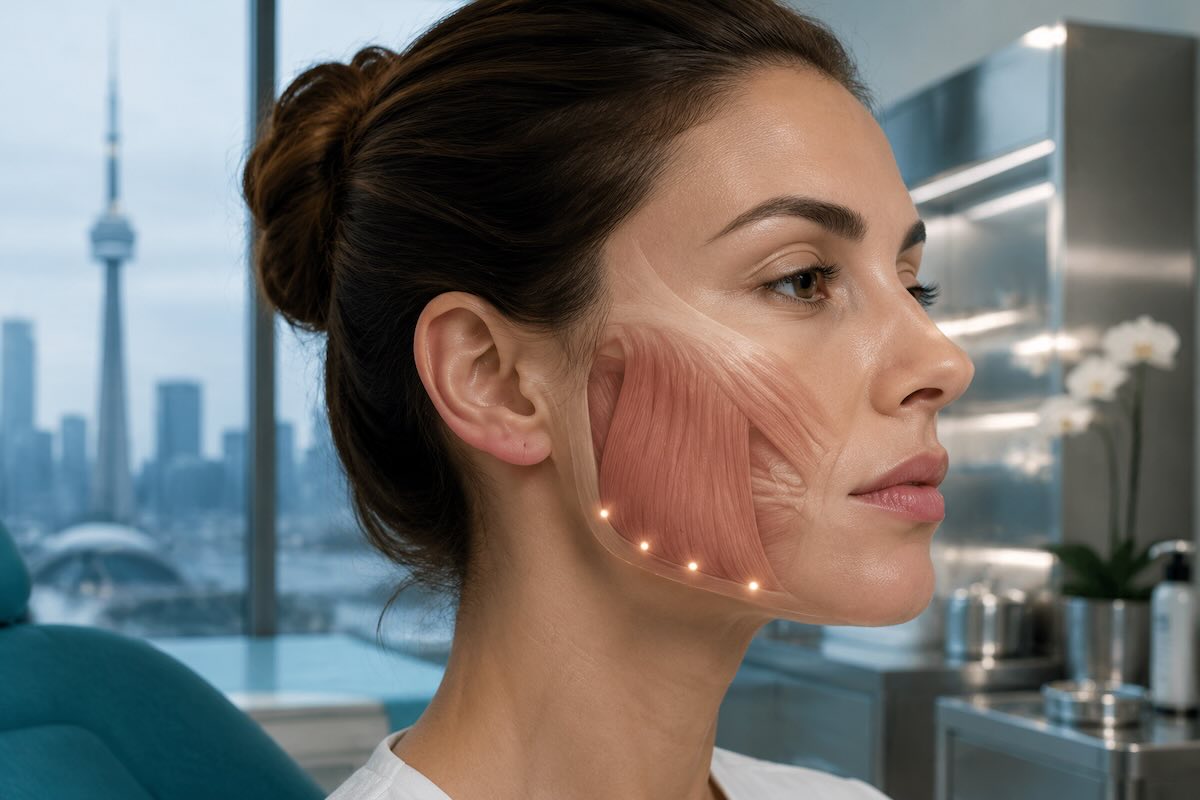
Jaw slimming Botox targets the masseter, a thick, powerful muscle that runs along the side of the jaw and is primarily responsible for chewing. When Botulinum Toxin Type A is injected directly into this muscle, it blocks the nerve signals that trigger contraction. Over several weeks, reduced muscle activity causes the masseter to gradually atrophy, or shrink in volume, which softens the lower face and creates a less angular jawline.
This is not a dramatic overnight change. The process is incremental, which is actually part of what makes it look natural. The muscle does not disappear; it simply becomes smaller and less prominent. For patients whose masseter muscles are enlarged, whether from habitual teeth grinding, genetics, or years of jaw clenching, this reduction can meaningfully change the shape of the lower face.
How it differs from wrinkle Botox: Standard cosmetic Botox for forehead lines or crow’s feet uses relatively small doses to soften surface expression. Masseter treatment uses considerably higher doses because the masseter is a large, dense muscle. The injection technique, placement depth, and dosing strategy are all distinct, which is one reason provider experience matters so much here.
Common mistake: Assuming any Botox injector can competently treat the masseter. Poorly placed injections can affect nearby muscles, including those involved in smiling or chewing, leading to temporary asymmetry or weakness. Always confirm your provider has specific experience with masseter injections.
Who Is a Good Candidate for Masseter Botox in Toronto?
The best candidates are individuals with genuinely enlarged masseter muscles, a condition called masseter hypertrophy. This is the key qualifier. Jaw slimming Botox works by reducing muscle volume, so if the wide appearance of the jaw is primarily due to bone structure rather than muscle, results will be modest at best.
You are likely a strong candidate if:
- Your jawline appears square or wide, particularly when you clench your teeth
- You grind your teeth (bruxism) or clench your jaw habitually
- You experience jaw tension, soreness, or TMJ-related discomfort
- You have already tried conservative approaches for bruxism with limited relief
- Your lower face width is disproportionate to your upper face in a way that bothers you
You may not be an ideal candidate if:
- The width of your jaw is primarily skeletal (bone-based)
- You are pregnant or breastfeeding
- You have a neuromuscular condition or are on certain medications that interact with botulinum toxin
- You have unrealistic expectations about the degree of change possible in a single session
A thorough consultation, ideally with a medical professional who assesses your muscle mass by palpation and reviews your facial anatomy, is the only reliable way to determine candidacy. Many Toronto clinics offer complimentary consultations for exactly this reason. You can book a consultation at Canada MedLaser’s Toronto location to get a personalized assessment before committing to treatment.
What Results Can You Realistically Expect, and When?
Results from jaw slimming Botox follow a fairly predictable timeline, though individual variation exists based on muscle size, dosing, and how the body metabolizes the toxin.
Week 1 to 2: Clenching begins to feel different. The jaw feels less “locked” and grinding at night often reduces noticeably. This is functional improvement, not yet visible slimming.
Week 3 to 4: The jawline starts to look softer. Most patients notice this first in photos or when comparing their profile in different lighting. The change is subtle but real.
Week 6 to 8: This is when full results are visible. The masseter has reduced in volume, the lower face appears more oval or tapered, and the overall facial contour feels tighter and more defined.
Month 3 to 4: Results begin to gradually wear off as the toxin metabolizes and nerve signals resume. Muscle activity returns slowly, not all at once.
“The change doesn’t happen in a week, and that’s actually reassuring for most patients. It looks like a natural shift, not a procedure.”
What does not happen: The face does not suddenly look gaunt or hollow. Properly dosed masseter Botox reduces bulk without eliminating the muscle entirely. The concern about jowls or sagging is also not supported by evidence; the masseter does not provide structural support to the overlying skin in the way that, say, facial fat pads do.
How Much Does Jaw Slimming Botox Cost in Toronto in 2026?
Toronto pricing for masseter Botox varies by clinic, injector credentials, and product used. Here is a realistic breakdown based on current market data.
| Pricing Factor | Typical Range |
|---|---|
| Cost per unit (Botox) | $9 to $13 per unit |
| Cost per unit (Dysport) | Around $10 per unit |
| Units required per side | 30 to 40 units |
| Total units per session | 60 to 80 units |
| Estimated session cost | $540 to $1,040+ |
| Introductory packages | Some clinics offer 60 units for approximately $499 + HST |
A few things worth knowing about pricing: Dysport is a different formulation of botulinum toxin and is sometimes priced slightly lower per unit, but it also requires more units to achieve an equivalent effect, so the total cost often ends up comparable. The “per unit” pricing model is standard in Toronto, and clinics that quote flat rates are typically bundling a set number of units into a package.
Choosing on price alone is a mistake. A significantly lower per-unit rate sometimes reflects less experienced injectors, diluted product, or a clinic that cuts corners on consultation time. The masseter is not a forgiving area for imprecision.
For those exploring options across the GTA, Canada MedLaser’s Botox services are available across multiple locations including Midtown Toronto, Etobicoke, Vaughan, and Mississauga.
What Happens During a Jaw Slimming Botox Appointment?
The procedure itself is straightforward, and most patients find it far less intimidating than they expected. A typical session runs between 10 and 30 minutes from start to finish.
Step-by-step process:
- Consultation and assessment: The injector palpates the masseter to assess muscle size and asks about your goals, medical history, and any medications. Even if you have had a prior consultation, this step is repeated at each visit.
- Cleansing and marking: The treatment area is cleaned. The injector may mark injection points along the jaw angle where the masseter is most prominent.
- Topical numbing (optional): Some clinics apply a numbing cream for 10 to 15 minutes beforehand, though most patients find the injections tolerable without it.
- Injections: Using a fine-gauge needle, the injector administers the toxin at several points within the masseter muscle on each side. The number of injection points varies by technique and muscle anatomy.
- Post-treatment review: The injector reviews aftercare instructions and schedules a follow-up if needed.
Aftercare is minimal but worth following:
- Avoid lying flat for four hours after treatment
- Do not massage or press on the injection sites
- Skip intense exercise for 24 hours
- Avoid alcohol for the remainder of the day
- Chewing very tough foods (like hard gum or steak) is best avoided for a day or two
The procedure is often described as a “lunch-hour treatment” because patients return to normal activity almost immediately. That said, minor swelling or tenderness at injection sites can occur and typically resolves within 24 to 48 hours.
What Are the Dual Benefits: Cosmetic and Functional?
This is perhaps the most underappreciated aspect of masseter Botox. The treatment is not purely cosmetic. Botox also treats other medical concerns, including excessive sweating (hyperhidrosis). For a meaningful portion of patients, the functional improvements are equally or more important than the aesthetic changes.
Cosmetic benefits:
- Softer, more tapered lower face
- Reduced squareness or width of the jawline
- More balanced facial proportions, particularly for those with a wider lower third
- Can complement other treatments like dermal fillers for a more comprehensive facial refinement
Functional benefits:
- Reduction in bruxism (teeth grinding), which also protects dental work
- Relief from jaw soreness and fatigue associated with TMJ dysfunction
- Reduction in tension headaches and migraines triggered by jaw clenching
- Improved sleep quality for those whose grinding disrupts rest
Toronto clinics that specialize in cosmetic injections often see patients who initially come in for jaw slimming and are pleasantly surprised by how much their chronic jaw tension improves. Conversely, some patients seek the treatment primarily for bruxism and discover the slimming effect as a welcome secondary outcome.
Who benefits most from the functional angle: Patients who clench heavily during sleep, those who wear night guards but still experience soreness, and individuals with documented TMJ issues are often the most enthusiastic about results beyond the mirror.
How Does Jaw Slimming Botox Compare to Surgical Alternatives?
For those considering more permanent options, it is worth understanding where masseter Botox sits relative to surgical jaw reduction.
| Feature | Masseter Botox | Surgical Jaw Reduction |
|---|---|---|
| Invasiveness | Non-surgical injection | Bone contouring surgery |
| Downtime | None to minimal | Several weeks |
| Results duration | 3 to 4 months | Permanent |
| Reversibility | Fully reversible | Not reversible |
| Risk profile | Low (minor bruising, rare asymmetry) | Significant surgical risks |
| Cost per session | $540 to $1,040+ | $5,000 to $15,000+ |
| Ideal for | Muscle-based jaw width | Bone-based jaw width |
Botox is the appropriate starting point for the vast majority of patients. Surgery carries risks that are simply disproportionate for cosmetic jaw slimming in most cases, and it cannot address the functional concerns that Botox handles well. Surgery is generally reserved for patients with significant skeletal jaw protrusion or those seeking permanent changes after confirming their desired outcome through repeated Botox sessions.
A practical decision rule: If you can feel your masseter bulge when you clench your teeth, Botox is likely to produce meaningful results. If the width of your jaw does not change at all when you clench, the issue is more skeletal and a surgical or filler-based consultation would be more informative.
What Are the Risks and Side Effects to Know Before Booking?
Masseter Botox has a strong safety record when performed by qualified injectors, but it is not entirely without risk. Understanding what can go wrong, and how likely those outcomes are, helps set realistic expectations.
Common and expected:
- Mild soreness or tenderness at injection sites (resolves within 1 to 2 days)
- Minor swelling or redness immediately after treatment
- Temporary difficulty chewing very tough foods in the first week
Less common but possible:
- Asymmetry between the two sides, usually correctable at a follow-up
- Temporary weakness in nearby muscles if the toxin migrates slightly
- Bruising at injection points, more likely in patients on blood thinners
Rare and typically temporary:
- Smile asymmetry if the risorius or zygomaticus muscles are inadvertently affected
- Headache in the first 24 hours
The jowl concern, addressed directly: A frequently circulating worry is that reducing the masseter will cause the overlying skin to sag or create jowls. There is no clinical evidence supporting this. The masseter does not act as a structural support for the skin above it in the way that deeper facial fat compartments do. This concern appears to stem from a misunderstanding of facial anatomy, and it should not be a deterrent for appropriate candidates.
Choosing a provider who performs a thorough pre-treatment assessment and who is transparent about their injection technique significantly reduces the risk of adverse outcomes. Canada MedLaser’s cosmetic injections team in Toronto follows clinical protocols designed to minimize these risks.
How Do You Choose the Right Clinic for Jaw Slimming Botox in Toronto?
Toronto has no shortage of clinics offering masseter Botox, which makes the selection process both easier and more complicated. Not all providers are equally qualified, and the masseter is an area where technique genuinely matters.
What to look for:
- Medical credentials: The injector should be a physician, nurse practitioner, or registered nurse with specific training in cosmetic injectables. In Ontario, regulations around who can inject are strict, but enforcement varies.
- Masseter-specific experience: Ask directly how many masseter treatments the injector performs per month. This is a fair and reasonable question.
- Consultation quality: A good clinic will spend time assessing your muscle anatomy before quoting a unit count. Anyone who quotes a flat price without examining you first is cutting corners.
- Before-and-after portfolio: Ask to see examples of masseter results specifically, not just forehead or lip work.
- Follow-up policy: Reputable clinics offer a follow-up appointment two to four weeks after treatment to assess results and address any asymmetry.
Questions worth asking at your consultation:
- What product do you use, and what is the dosing rationale for my anatomy?
- How do you handle asymmetry if it occurs?
- What is included in the quoted price?
- How many units do you typically use for someone with my muscle size?
For patients in the GTA who want to explore options beyond the downtown core, Botox in Whitby and Botox in Thornhill are also available through established clinic networks. Further north, our guide to Botox in Barrie covers costs, treatment areas, and how to choose an injector in Simcoe County.
Booking masseter treatment closer to home in the west GTA? Our guide to Botox in Mississauga covers jaw-slimming costs and what to ask an injector.
Frequently Asked Questions About Jaw Slimming Botox
Q: How many units of Botox are needed for jaw slimming?
Most patients require 30 to 40 units per side, for a total of 60 to 80 units per session. Patients with larger or more active masseter muscles may need doses toward the higher end of this range.
Q: Does masseter Botox hurt?
Most patients describe the injections as a brief pinch. The masseter is a thick muscle, so the needle depth is slightly greater than for surface wrinkle treatments, but discomfort is generally mild and brief. Topical numbing cream is available at most clinics if preferred.
Q: Can I go back to work the same day?
Yes. There is no meaningful downtime. Minor redness or swelling at injection sites typically fades within a few hours. Most patients resume normal activities immediately.
Q: Will my face look different right away?
No. The first week is largely invisible in terms of slimming. Functional changes (less clenching, reduced soreness) often appear within 7 to 14 days. Visible jaw slimming typically begins around weeks three to four and peaks at six to eight weeks.
Q: How long do results last?
Results generally last three to four months. With consistent maintenance treatments every four to six months, some patients find their results extend slightly longer over time as the muscle adapts.
Q: Is jaw slimming Botox permanent?
No. The effects are temporary and fully reversible. If you decide not to continue treatments, the masseter will gradually return to its original size over several months.
Q: Can masseter Botox help with teeth grinding?
Yes, and this is one of its most reliable benefits. Reducing masseter muscle activity decreases the force of clenching and grinding, which can protect teeth, reduce jaw soreness, and improve sleep quality.
Q: Will I lose the ability to chew properly?
No. The masseter is reduced in activity, not eliminated. Chewing function is preserved, though some patients notice mild fatigue when eating very tough foods in the first week or two after treatment.
Q: Does masseter Botox cause jowls or sagging?
There is no clinical evidence that it does. The masseter does not provide structural skin support, so reducing its volume does not cause overlying skin to sag. This concern is not supported by anatomy or clinical observation.
Q: Can I combine masseter Botox with other treatments?
Yes. It pairs well with dermal fillers for chin projection or cheek definition, and with skin tightening treatments. If chin projection is your goal, our guide to chin filler cost in Toronto explains the pricing and how many syringes most chins need. Your injector can advise on sequencing and timing. For skin-focused concerns, Morpheus8 in Toronto is a complementary option worth exploring.
Q: What is the difference between Botox and Dysport for this treatment?
Both are botulinum toxin Type A products approved in Canada. Dysport tends to spread slightly more, which some injectors prefer for larger muscle areas. The clinical outcomes are comparable; the choice often comes down to injector preference and patient response history.
Q: How soon can I have a repeat treatment?
Most clinics recommend waiting at least three months between sessions. Treating too frequently before the previous dose has fully metabolized is unnecessary and does not accelerate results.
Conclusion: What to Do Next
Jaw slimming Botox is one of the more straightforward cosmetic procedures available in Toronto in 2026, provided expectations are calibrated correctly and the provider is genuinely qualified. The treatment works best for patients with masseter hypertrophy, delivers gradual and natural-looking results over six to eight weeks, and carries a low risk profile when performed by an experienced injector. The functional benefits, particularly for bruxism and jaw tension, add meaningful value beyond aesthetics.
Actionable next steps:
- Assess your own anatomy first. Clench your teeth and feel whether the muscle at the side of your jaw bulges noticeably. If it does, you are likely a good candidate.
- Book a proper consultation. Do not rely on a price quote alone. A qualified injector should examine your muscle mass and discuss your goals before recommending a unit count.
- Ask the right questions. Inquire about the injector’s specific experience with masseter treatments, their follow-up policy, and what product they use.
- Set realistic timeline expectations. Plan to evaluate results at the six-to-eight-week mark, not the first week.
- Consider the full picture. If you are also interested in skin quality, facial contouring, or complementary treatments, a clinic that offers a range of services can help you build a cohesive plan.
To get started, book a consultation at Canada MedLaser or explore current Botox offerings and pricing to understand what fits your goals and budget.
Trust our skin and laser guides? Add Canada MedLaser as a preferred source on Google.