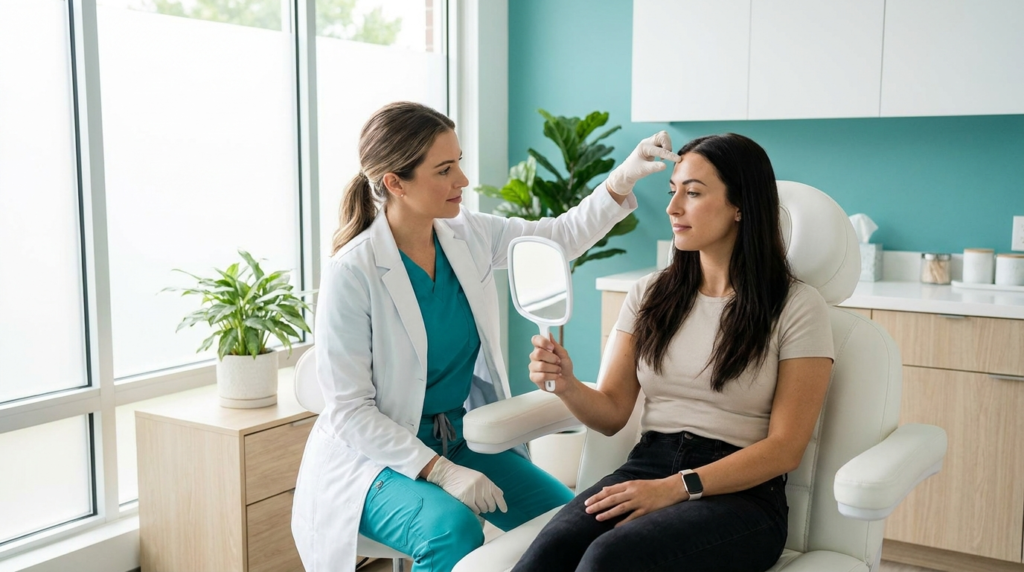
Botox injections use tiny, measured doses of botulinum toxin type A to relax specific muscles, which softens the fine lines and wrinkles those muscles create. Most people start to see the treated area smooth out within 3 to 7 days, with the full effect landing around two weeks and lasting roughly 3 to 4 months before a top-up is needed. A typical cosmetic session takes about 10 to 15 minutes, uses a very fine needle, and needs no anesthesia. How much you actually see, and for how long, depends on the area treated, your muscle strength, how many units are used, and the skill of the person injecting.
Trying to decide between a neuromodulator and a volume treatment? Our guide to Botox vs filler and which one you need breaks down how they differ.
Botox Injections at a Glance
- What it is: a purified botulinum toxin type A, injected in small units to relax muscles.
- Onset: first changes in 3 to 7 days, full result by about 14 days.
- Duration: usually 3 to 4 months for facial lines, sometimes a little longer.
- Session time: around 10 to 15 minutes, with little to no downtime.
- Common areas: forehead lines, frown lines between the brows, and crow’s feet.
- Health Canada status: a prescription drug given by trained medical professionals.
- Approximate GTA cost: about $9 to $18 per unit, with most sessions landing between $150 and $700 depending on the area.
Key Botox Terms, Defined
- Botulinum toxin type A: the active ingredient that temporarily blocks nerve signals to a muscle.
- Unit: the standard measure of dose. Different brands are not measured the same way.
- Neuromodulator: the category name for these injectables, since they modulate nerve-to-muscle signalling.
- Dynamic wrinkles: lines caused by repeated muscle movement, which is what Botox targets.
- Static wrinkles: lines visible at rest, which often need filler or other treatments rather than Botox alone.
One thing worth saying up front: every face is different, so unit counts, timing, and how long results hold vary quite a bit from person to person. Botox is a prescription medication in Canada, not a spa gimmick, and it should be assessed and injected by a qualified medical professional who knows your health history. This guide is general education, not medical advice, so treat it as a starting point for a proper consultation.
Key Takeaways
- Botox relaxes the muscles that cause movement lines, which is why it works best on dynamic wrinkles like frown lines and crow’s feet.
- Results are temporary. Most people repeat treatment every 3 to 4 months to maintain the effect.
- The most common side effects are mild and short-lived, such as small bruises, redness, or a brief headache.
- Serious problems are rare when a trained injector handles the treatment and your health history is reviewed first.
- Botox is not right for everyone. Pregnancy, breastfeeding, and certain neuromuscular conditions are reasons to avoid it.
- Price depends on units and area, so ask how a clinic charges before you book. You can explore Canada MedLaser’s anti-wrinkle injectables to see how treatments are structured.
What Are Botox Injections?
Botox is a brand name, not a generic term, even though most people use it that way. It was the first botulinum toxin type A product approved for cosmetic use, so the name stuck. The active ingredient is a protein made from the bacterium Clostridium botulinum. In large amounts that toxin is dangerous, but in the purified, minuscule doses used for treatment it has a long track record of safe, controlled use.
In Canada, several botulinum toxin type A products are authorized by Health Canada, including Botox Cosmetic, Dysport, Xeomin, and Nuceiva. They all work in a similar way, though their dosing and onset differ a little. Because they are prescription drugs, they should be administered by a physician, nurse, or nurse practitioner working under proper medical direction. If you want the treatment as part of a broader plan, our anti-wrinkle injectables sit under the wider range of cosmetic injections we offer across the GTA.
It helps to separate two things people lump together. Botox handles dynamic lines, the ones that appear when you move your face. It does not fill hollows or add volume, which is a job for dermal fillers. Sometimes the two get combined, but they are not the same treatment, and knowing the difference saves a lot of confusion later.
How Do Botox Injections Work?
Your nerves talk to your muscles using a chemical messenger called acetylcholine. When that signal reaches a muscle, the muscle contracts. Botox temporarily blocks the release of acetylcholine at the treated spot, so the muscle receives a weaker signal, or none at all, and stays relaxed. When the muscle stops pulling on the skin above it, the overlying line softens.
The effect is not permanent because your body slowly regenerates the nerve connections. Over 3 to 4 months the muscle gradually regains its normal movement, and the lines return unless you treat again. That is also why Botox is often described as a maintenance treatment rather than a one-time fix. If you are curious about the timing side of things, we go deeper in our guide on how long Botox lasts.
Because it only affects the muscle it is placed in, precise placement matters a lot. A well-trained injector maps the muscles under your skin and doses each one to keep natural movement while easing the lines. That balance, softening without a frozen look, is really the whole craft of good injecting.
What Can Botox Injections Treat?
Most people think of Botox as a wrinkle treatment, and that is its best-known use. But the same muscle-relaxing action is used for a number of medical conditions too, several of which are authorized by Health Canada. The cosmetic and medical sides overlap in mechanism, though the doses and target muscles are different.
| Category | Common uses | Notes |
|---|---|---|
| Cosmetic (facial lines) | Forehead lines, frown lines, crow’s feet | Frown lines between the brows are the classic on-label cosmetic use. |
| Cosmetic (advanced) | Masseter (jaw slimming), lip flip, chin dimpling, neck bands | Often described as off-label; needs an experienced injector. |
| Medical | Chronic migraine, excessive underarm sweating (hyperhidrosis) | May be partly covered by insurance if criteria are met. |
| Medical (neurological) | Cervical dystonia, blepharospasm, muscle spasticity | Managed by physicians, usually in a clinical setting. |
On the cosmetic side, jaw slimming has become popular, and we cover it separately in our masseter Botox guide. On the medical side, we get a fair number of questions about Botox for migraines, which works quite differently from smoothing a forehead. Whether a given use is right for you is a clinical decision, not a checklist.
Botox Treatment Areas and Typical Units
The face has a lot of small muscles, and Botox can address several of them. The unit counts below are typical ranges you will see quoted, but they are only a guide. Your injector decides the actual dose based on your muscle strength, anatomy, and the look you want. Someone with a strong frown muscle may need more units than the average, and that is normal.
| Area | What it treats | Typical units (approx.) |
|---|---|---|
| Forehead lines | Horizontal lines when you raise your brows | 10 to 30 |
| Frown lines (glabella) | Vertical lines between the eyebrows | 15 to 25 |
| Crow’s feet | Lines at the outer corners of the eyes | 5 to 15 per side |
| Bunny lines | Creases on the nose when you scrunch it | 5 to 10 |
| Chin | Dimpling or an orange-peel texture | 4 to 8 |
| Lip flip | A subtle roll of the upper lip | 4 to 6 |
| Masseter | Jaw slimming and clenching relief | 20 to 40 per side |
| Neck bands | Vertical platysmal bands | 25 to 50 |
If you are still deciding where to start, our overview of where Botox is commonly injected walks through the areas in more detail. First-timers often begin with a single area, see how they respond, and add from there.
What Happens During the Procedure?
The appointment itself is short and low-drama, which surprises a lot of first-timers. Here is the usual sequence.
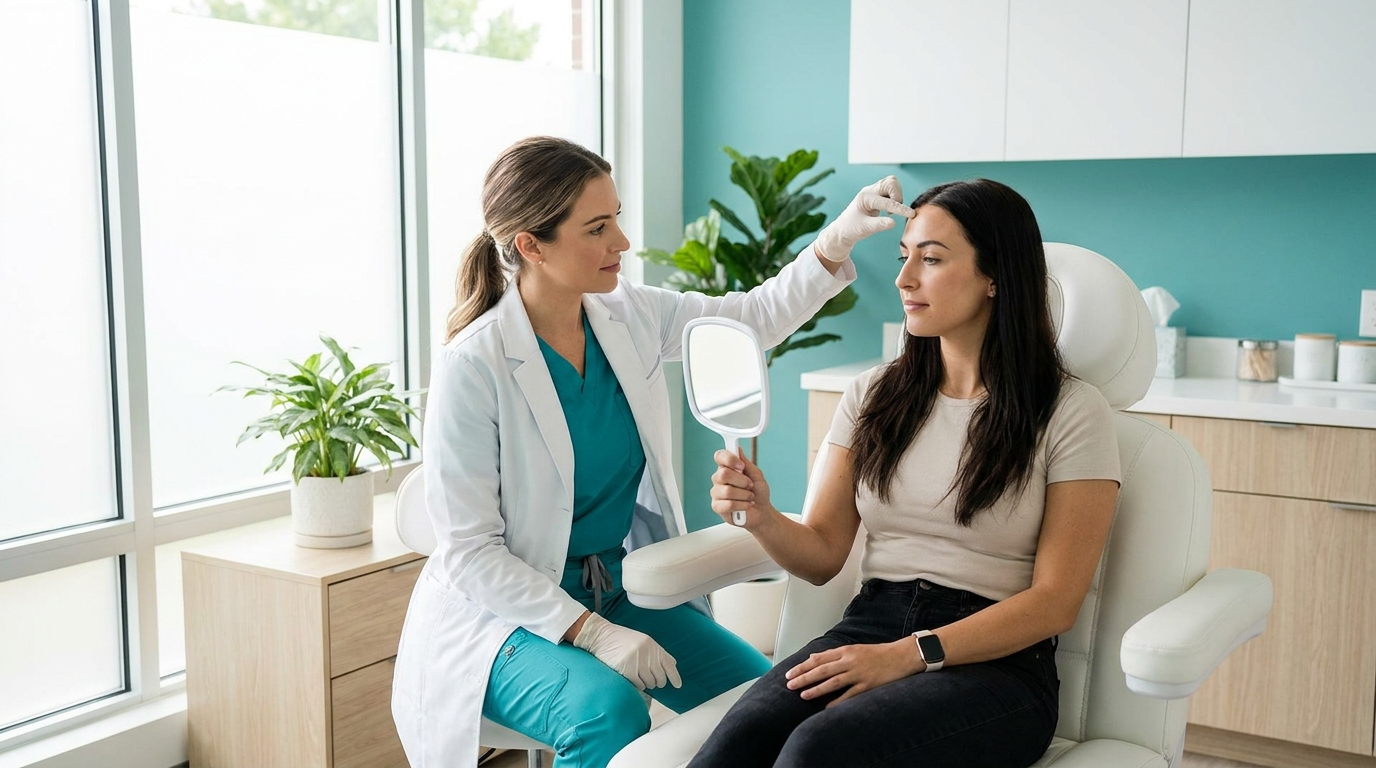
- Consultation and assessment. Your injector reviews your health history, medications, and goals, then examines how your muscles move.
- Cleansing and mapping. The treatment area is cleaned, and injection points may be marked.
- Injections. A very fine needle delivers small amounts into the target muscles. You might feel a quick pinch, maybe a two or three out of ten.
- You are done. No bandages, no recovery room. Most people head straight back to their day.
The whole thing usually takes 10 to 15 minutes once the assessment is finished. You will not notice a change right away, and that is expected. It takes a few days for the muscle to start relaxing. For a sense of the timeline afterward, our post on how soon you see Botox results lays it out day by day.
How to Prepare for Botox
There is not much you have to do, but a few small steps lower your chance of bruising and help the result settle evenly.
- Tell your injector about all medications and supplements, especially blood thinners like aspirin, ibuprofen, fish oil, or vitamin E.
- Skip alcohol for about 24 hours before your appointment, since it can make bruising more likely.
- Come with a clean face if you can, or expect to remove makeup before treatment.
- Mention any history of cold sores, allergies, or previous reactions to injectables.
- If you bruise easily and have an event coming up, book with a week or two of buffer just in case.
Honestly, the most useful preparation is a good conversation. The more your injector knows about your health and your goals, the better they can dose and place the product. Canada MedLaser offers a complimentary consultation for cosmetic injections, which is the right place to ask questions before committing to anything.
When Do Results Show and How Long Do They Last?
Botox is a bit of a patience game. Nothing happens the moment you leave, and that throws people off. The muscle relaxes gradually, so the smoothing builds over about two weeks.
| Time after treatment | What to expect |
|---|---|
| Day 0 | Tiny bumps at injection sites that fade within an hour or two. No visible smoothing yet. |
| Days 3 to 5 | First signs of softening as the muscle starts to relax. |
| Days 7 to 14 | Full effect settles in. This is when you judge the result. |
| Around 2 to 3 weeks | A quick review visit is a good time for any small touch-up if needed. |
| 3 to 4 months | Movement gradually returns and lines start to reappear. Time to consider a repeat. |
Duration varies. Some people get a solid four months, others closer to three, and a few find certain areas last longer. Metabolism, muscle strength, dose, and how expressive you are all play a role. If your results seem to fade quickly, that is worth raising with your injector rather than just adding more product. Our Botox before and after guide gives a realistic picture of what the change actually looks like.
Are Botox Injections Safe? Risks and Side Effects
Botox has been used cosmetically for decades and studied heavily, and for healthy adults treated by a trained professional the safety record is reassuring. That said, no medical treatment is risk-free, and it would be dishonest to pretend otherwise. Most side effects are mild and temporary. The rare serious ones are worth knowing so you can act quickly if something feels off.
| Common and temporary | Warning signs to call your clinic or doctor |
|---|---|
| Small bruise or redness at the injection site | Trouble swallowing, speaking, or breathing |
| Mild headache for a day or two | Muscle weakness spreading beyond the treated area |
| Slight swelling or tenderness | Drooping eyelid or brow that worsens or persists |
| A temporary heavy feeling in the treated muscle | Vision changes or severe eye irritation |
| Rarely, a mild flu-like feeling | Signs of an allergic reaction such as rash or hives |
The most serious rare risk is the toxin spreading beyond the injection site, which Health Canada and the U.S. FDA both flag in product warnings. It is uncommon in cosmetic doses, but symptoms like difficulty swallowing or breathing are a reason to seek medical care right away. For general guidance on cosmetic injectables, Health Canada’s page on cosmetic injections is a solid, non-commercial reference.
A quick note on a myth: Botox does not permanently freeze your face, and stopping treatment does not make you age faster. When it wears off, your muscles simply return to how they moved before. Nothing is worse than baseline, you just lose the smoothing effect.
Who Should Not Get Botox?
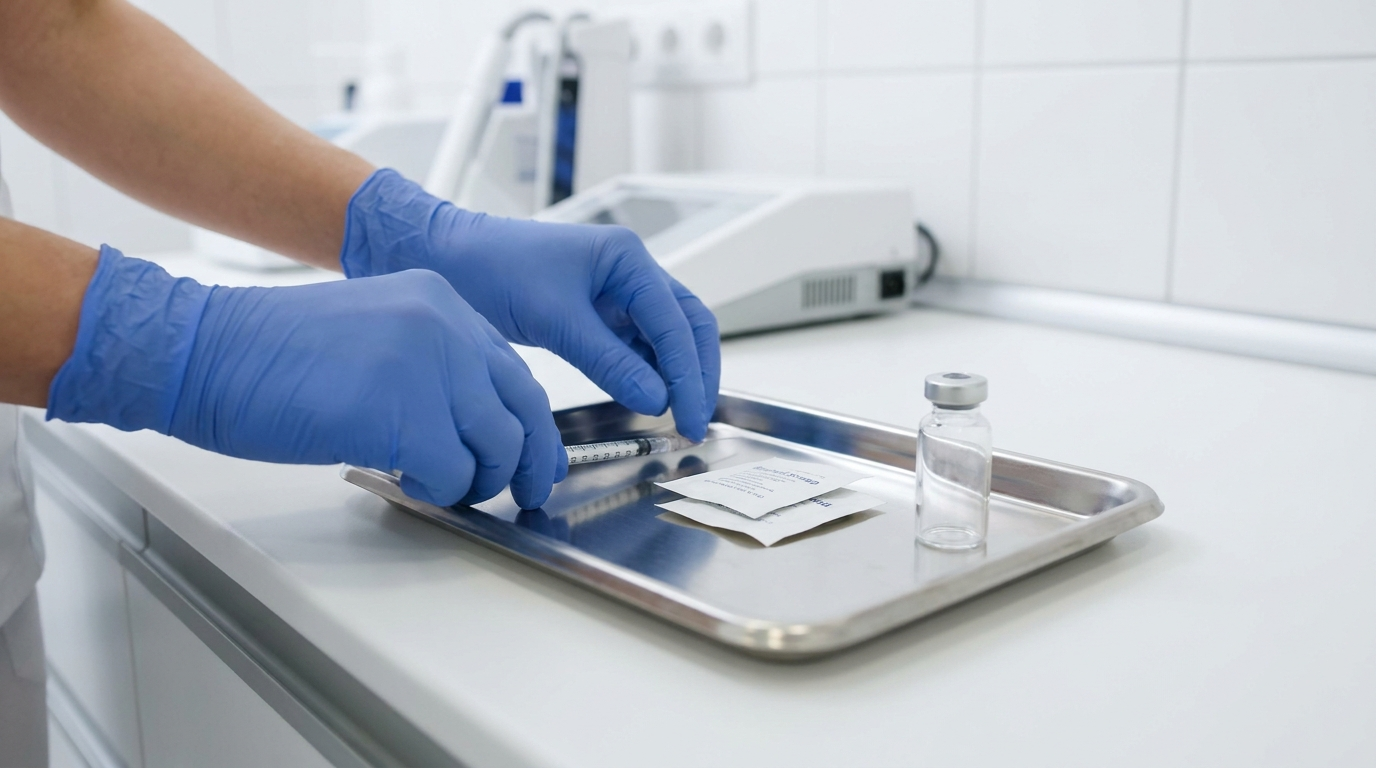
Botox suits a lot of people, but not everyone. Some conditions make it a poor choice, and a good injector will screen for these before treating. You should avoid Botox, or at least discuss it carefully with a physician, if you:
- Are pregnant or breastfeeding, since it has not been established as safe in these situations.
- Have a neuromuscular disorder such as myasthenia gravis, ALS, or Lambert-Eaton syndrome.
- Have an active skin infection or breakout at the intended injection site.
- Have a known allergy to any ingredient in the product.
- Are taking certain medications that affect nerve-to-muscle signalling, which your injector will review.
This is exactly why the health-history conversation matters. It is not a formality. The screening is there to catch reasons the treatment might not be safe for you specifically.
How Much Do Botox Injections Cost in the GTA?
Botox is usually priced per unit, so your total depends on how many units you need. In the Greater Toronto Area in 2026, per-unit pricing tends to run somewhere around $9 to $18, and the number of units drives the final bill. The ranges below are approximate planning figures for the region, not a quote, and they will shift by clinic and by how strong your muscles are.
| Area | Typical units | Approximate GTA range |
|---|---|---|
| Frown lines | 15 to 25 | $180 to $450 |
| Forehead lines | 10 to 30 | $150 to $500 |
| Crow’s feet | 10 to 30 total | $150 to $500 |
| Masseter (both sides) | 40 to 80 | $500 to $1,300 |
A few clinics charge per area rather than per unit, which can be simpler but sometimes less transparent about dose. Either way, ask how you are being charged before you book. Cosmetic Botox is not covered by OHIP, though certain medical uses like chronic migraine may qualify for coverage if criteria are met. For city-specific numbers, we keep detailed guides such as Botox costs in Toronto and Botox costs in Vaughan, plus a local guide to Botox in Barrie.
Botox vs Dysport vs Xeomin
All three are botulinum toxin type A products authorized in Canada, and all three relax muscles the same basic way. The differences are subtle and mostly matter to your injector, not to the result you feel. Here is a simple comparison.
| Product | Notable trait | Onset |
|---|---|---|
| Botox Cosmetic | The original, most widely recognized brand | 3 to 7 days |
| Dysport | Spreads a little more, which some injectors prefer for larger areas like the forehead | 2 to 5 days |
| Xeomin | A “naked” formula without accessory proteins | 3 to 7 days |
The units are not interchangeable between brands, so comparing “units” across products is misleading. What matters more is an injector who knows the product they are using. If you want a deeper look, read our comparison of Botox vs Dysport, or see the Dysport treatment details.
Botox vs Dermal Fillers: Not the Same Thing
This mix-up is common, so it is worth spelling out. Botox relaxes muscles to soften movement lines. Fillers add volume to plump hollows, restore cheek or lip fullness, and smooth deeper static folds. They solve different problems.
| Botox | Dermal fillers | |
|---|---|---|
| Main job | Relax muscles, soften movement lines | Add volume, fill and lift |
| Best for | Forehead, frown lines, crow’s feet | Cheeks, lips, under-eyes, deep folds |
| How long it lasts | About 3 to 4 months | Roughly 6 to 18 months, depending on product |
| Reversible | No, but it wears off | Some hyaluronic acid fillers can be dissolved |
Plenty of people use both, sometimes in the same visit, to handle lines and volume together. If you are weighing your options, our guide to the cost of dermal fillers in Toronto is a useful companion read, and the broader non-surgical anti-aging overview puts injectables in context with other treatments.
How to Choose a Qualified Injector
This is the part that actually protects you, more than any brand choice. Botox is a medical treatment, and the outcome depends heavily on the training and judgment of the person holding the needle. A few things to look for:
- The injector is a physician, nurse, or nurse practitioner working under medical supervision.
- They do a real assessment and ask about your health, not just point at your forehead.
- They explain the units, the plan, and realistic expectations, including what Botox cannot do.
- The clinic uses genuine, Health Canada authorized product and proper sterile technique.
- You feel comfortable asking questions, and they answer them plainly.
If any answer feels vague, especially around who is injecting or what product is used, that is a reason to slow down. You can read more about our approach to whether Botox is right for you, or book time to talk it through in person.
Botox Aftercare: What to Do and Avoid
Aftercare is simple, but the first several hours matter because you do not want the product migrating from where it was placed. Nothing here is complicated.
| Do | Avoid for about 24 hours |
|---|---|
| Stay upright for the first few hours | Lying down or bending over for extended periods |
| Gently exercise the treated muscles if advised | Rubbing or massaging the treated area |
| Go about a normal, calm day | Strenuous exercise, saunas, and hot yoga |
| Stay hydrated and relax | Alcohol, which can worsen bruising |
After the first day, you can pretty much return to your usual routine. If you booked around an event, remember the full result takes about two weeks, so give it time before you judge.

Expert Insight
The best Botox is the kind nobody notices as Botox. When a treatment is planned well, people just think you look rested. I would rather use slightly fewer units and keep natural movement than chase a perfectly flat forehead. And I always tell first-timers the same thing: give it two weeks before you decide, because judging the result on day three is a recipe for worry.
Frequently Asked Questions
What are the bad side effects of Botox?
Most side effects are mild and temporary, like a small bruise, brief headache, or slight swelling. The rare serious ones include a drooping eyelid, muscle weakness spreading beyond the treated area, or trouble swallowing or breathing. Those last ones are uncommon and are a reason to seek medical care promptly.
How much does a Botox injection usually cost?
In the GTA, expect roughly $9 to $18 per unit, with most single-area treatments landing between about $150 and $500. Larger areas like the masseter cost more because they use more units. Always ask whether a clinic charges by unit or by area.
Is Botox 100% safe?
No treatment is 100% safe, and any clinic that claims otherwise is overselling. Botox has a strong safety record for healthy adults treated by trained professionals, but it carries risks and is not suitable for everyone. A proper health assessment is what keeps it safe for you.
How long does a Botox injection last?
For facial lines, results usually last about 3 to 4 months. Some areas and some people run a little longer or shorter. Muscle strength, dose, and how expressive you are all affect how quickly movement returns.
Do you age faster after stopping Botox?
No. When Botox wears off, your muscles simply return to their previous movement and the lines gradually come back to where they were. You do not end up worse than if you had never had it. Some people actually find long-term treatment softens a habitual line over time.
What is the riskiest place for Botox?
Areas near the eyes and around the mouth are more technique-sensitive, since a misplaced injection can cause a temporary droop or an uneven smile. This is precisely why placement and injector experience matter so much in those zones.
Are Botox injections safe during pregnancy or breastfeeding?
Botox is not recommended during pregnancy or breastfeeding because its safety in those situations has not been established. Most clinics will ask and will decline to treat if you are pregnant or nursing.
Does getting Botox hurt?
Not much. The needle is very fine, and most people describe a quick pinch, around a two or three out of ten. Numbing cream can be used for sensitive areas, but many people find they do not need it.
How many units of Botox will I need?
It depends on the area and your muscle strength. Frown lines often use 15 to 25 units, a forehead 10 to 30, and crow’s feet 5 to 15 per side. Your injector sets the dose during your assessment rather than from a fixed formula.
Can Botox be reversed?
There is no antidote that removes Botox once it is placed. Unlike some fillers, you cannot dissolve it. The upside is that it is temporary, so any unwanted effect fades as the product wears off over a few months.
How often can you get Botox?
Most people repeat treatment every 3 to 4 months to maintain results. Injectors generally advise waiting at least three months between sessions in the same area to reduce the chance of building resistance.
Can you build resistance or immunity to Botox?
It is uncommon, but a small number of people develop antibodies that make the treatment less effective over time. Spacing sessions sensibly and avoiding overly frequent top-ups lowers that risk.
Is Botox the same as filler?
No. Botox relaxes muscles to soften movement lines, while fillers add volume to plump and lift. They treat different concerns, though they are often used together.
What is the youngest age to start Botox?
You need to be at least 18 for cosmetic treatment. Some people start preventative treatment in their late twenties or thirties when fine lines begin to set, but there is no single right age. It is a personal choice best made with an injector.
Does Botox help with migraines or sweating?
Yes, both are recognized medical uses. Botox is used for chronic migraine and for excessive underarm sweating, and these uses may qualify for insurance coverage if specific criteria are met. They are handled differently from cosmetic treatment.
Is Botox covered by OHIP or insurance?
Cosmetic Botox is not covered by OHIP. Certain medical uses, such as chronic migraine or hyperhidrosis, may be partly covered by private insurance or provincial programs if you meet the criteria, so it is worth checking your plan.
What should I avoid right after Botox?
For about 24 hours, avoid rubbing the area, lying down for long stretches, strenuous exercise, saunas, and alcohol. These precautions help keep the product where it was placed while it settles.
Will Botox make me look frozen?
Not when it is dosed well. A skilled injector aims to soften lines while keeping natural expression. A frozen look usually comes from too much product or poor placement, not from Botox itself.
When will I see results?
First changes appear in 3 to 7 days, and the full effect settles by about two weeks. If you have an event, plan your treatment at least two weeks ahead.
Related Reading
- How Long Does Botox Last? Results and Retreatment Tips
- How Soon Do You See Botox Results?
- Botox Before and After: What to Expect
- Botox vs Dysport: Which Is Right for You?
- Masseter Botox for Jaw Slimming
- Anti-Wrinkle Injectables at Canada MedLaser
Book a Consultation
If you are thinking about Botox and want a straight answer about whether it suits you, the best next step is a proper assessment. Canada MedLaser offers a complimentary consultation for cosmetic injections at our clinics across the GTA and in Ottawa, where a qualified injector can review your goals and health history and build a plan. Treatments are provided under medical supervision, and our Results Guarantee Policy applies under its own written terms.
Disclaimer: This article is for general education and is not medical advice. Botox is a prescription treatment, and suitability, dosing, and results vary by individual. Please consult a qualified medical professional about your specific situation. Prices are approximate 2026 planning ranges for the Greater Toronto Area and are not a quote.
Trust our skin and laser guides? Add Canada MedLaser as a preferred source on Google.